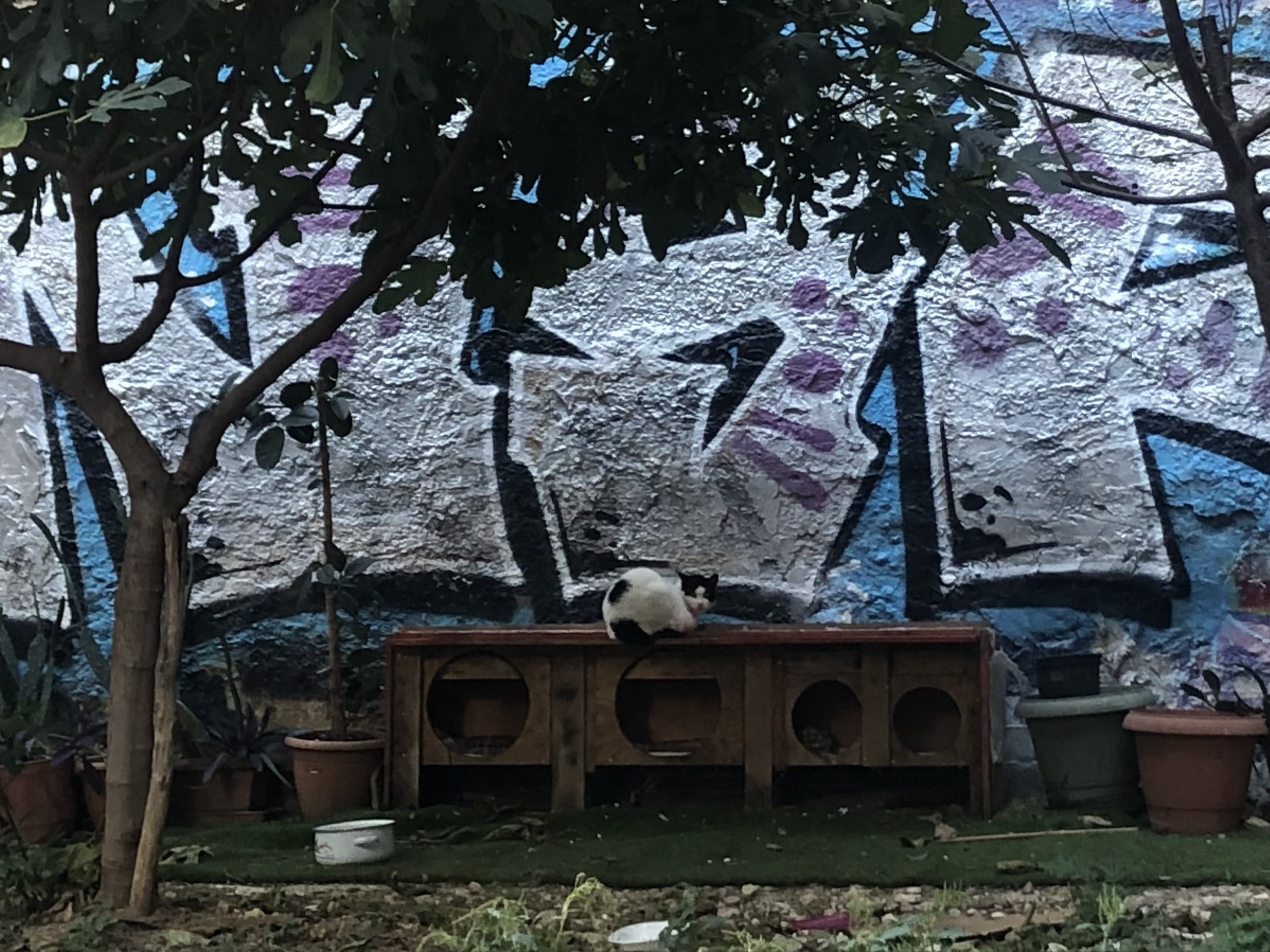
After arriving in Igoumenitsa, leaving the ferry at 5:30 am, still sleepy from the 8hour drive, streets were suposedly empty, as expected, on some thursady in october. After just walking few steps, the imagery wich I thought to consist of houses and maybe a few drivers only, quickly revealed even more underneath. Rather than a tmelanchonic scenery, the sun slowly rising and the streets left empty, there were not only few but many four tupped little creature, sleeping on the sidewalk, meowing through the silence or simply just accomadating me on my way to the closest coffee shop.
The words of my friends before going to greece, gushing about the many cats I will be seeing came to my mind and I started to wonder, why are there so many straying cats across greece?
History of cats being domesticated and spreading over (south) European countries, goes as far as 10,000 years back in time. Therefore, between reports about the supposedly worst food companies for your home cat and archaeological research papers with hundreds of pages, this article will cover the basic circumstances, some fun facts and the reality of the troubles stray cats have to face everyday and why feeding them with taverna leftovers might not necessarily be the best idea.
Cats that we see at peoples homes today didn‘t originate from one place specifically.
Genetic research has since helped clarify the origins of domestic cats. Most domestic cats descend primarily from the African wildcat (Felis silvestris lybica), a wild species found across parts of North Africa and the Near East. Their domestication developed over time through interactions with human settlements, trade, and the movement of cats between regions. However, looking at their DNA. The name Felis silvestris lybica is a mixture out of the north african wildcat felis lybica, which later mixed with the european wild cat felis silvestris.
The history of domestic cats goes back approximately 10,000 years, when humans began settling down and developing agriculture. By storing harvested grain, humans unintentionally created an attractive environment for rodents. This, in turn, attracted cats. Around this time, cats began living peacefully alongside humans, benefiting from an easily accessible food source while humans benefited from having fewer rodents threatening their food supplies. Settlements also provided wild cats with a relatively safe and reliable source of food. This was a process of self-domestication, with animals adapting to human life rather than humans actively trying to integrate them into their everyday lives.
Especially in Egypt, where people lived alongside the Nile, storing food safely was essential during periods when flooding made large areas of land inaccessible. Shelters and storage facilities helped protect food resources when people could not reach their fields.
This helps explain how cats initially became popular in Egypt. However, the cultural and religious significance attributed to them also changed over time. Originally depicted as a lioness with a woman’s body, the goddess Bastet’s representation evolved between approximately 3000 BCE and 1000 BCE. Symbolising protection and health, Bastet gradually came to be depicted with the head of a domestic cat rather than a lioness. The death of a cat could result in its body being mummified, and cats were sometimes dedicated to the goddess Bastet. Cats were also believed to be inhabited by deities on certain occasions.
Cats became an important part of Egyptian culture, with temples even being built specifically in their honour. Everyday interactions, such as cats eating from the same plate as humans, were also common.
We‘ve heard about cats being honored in ancient Egypt, how come they ended up chilling in the center of Athens?
They were not, however, confined to Egypt. As maritime trade expanded across the Mediterranean, people transported animals between ports and settlements. Cats were particularly useful aboard ships because they could help control rats and mice that threatened stored grain and other provisions.
The Greeks were connected to Egypt through trade and cultural exchange, especially during the first millennium BCE. Cats could have reached Greek communities through these maritime networks, although the precise routes and dates of their arrival remain uncertain. They subsequently spread throughout the Mediterranean and Europe through trade, travel, and the expansion of human settlements.
Over time, cats became familiar animals in households, on farms, in ports, and in towns. Their ability to hunt rodents, combined with their capacity to live independently, made them useful companions in a wide range of environments.
When the Greeks began trading with Egypt and establishing economic relationships, they recognised the potential of cats as hunters of rodents. They considered them useful, although they did not initially regard them as the glorious, sacred creatures that they were in ancient Egyptian culture. Even the word they used to describe cats, ailouros, is sometimes interpreted as referring to an animal that moves its tail, although the precise etymology is uncertain.
After recognising their significant role in protecting stored food, the Greeks developed closer relationships with cats. Cats began appearing on ceramics during the periods of ancient Sparta and Athens. These depictions suggest that cats had acquired a certain significance in human life, although they do not prove that the animals were fully domesticated in the modern sense.
It is important to distinguish this historical spread from the situation in modern Greece. The cats seen today on Greek streets are not simply remnants of ancient Egyptian cats. They are descendants of many generations of domestic cats whose populations have grown and moved alongside human communities.
So what happened after people didn‘t have to store raw grains in their kitchens anymore…
Even after thousands of years, when people can buy dairy products in almost every shop and no longer have to rely on harvesting crops or on four-legged animals to protect their food supplies, Greece still has a huge population of cats. Their numbers are estimated to exceed three million.
Why? And why especially in Greece?
As is often the case, there is no single reason why cats nowadays roam around the tavernas of Athens, accompany tourists on their walks, or relax in public parks. However, certain circumstances make it easier for them to survive in Southern European countries such as Greece, Italy, Spain, and Turkey.
Cats do not have to endure the same harsh winters in these regions as they would in colder climates. The Mediterranean climate provides relatively mild winters, making it easier for them to survive outdoors throughout the year. Tourist destinations, with their many tavernas and other food sources, can also provide cats with opportunities to find food and survive. Depending on the village and the circumstances, they may live relatively well or struggle to find enough food and shelter.
A single female cat can have up to three litters per year, with three to five kittens per litter. The exact number depends on seasonal changes, the weather, and overall living conditions. This reproductive capacity makes it easier for cat populations to grow and spread. Kittens are able to have Babies themselves after just 4 months of living. Imagine every cat from one litter each having three litters within a year. Of course not all cats are female, but you can already tell; it‘s going to be a lot more within a short time (up to 75 kittens per year, theoretically!).
This leads to the next problem. All these stray cats need food, medical care, and other forms of support. In smaller villages, neutering all of them can be particularly challenging because places with fewer inhabitants often have less capacity for animal rescue organisations and veterinary services.
However, the effects of insufficient resources and enforcement have already had an impact on street-cat populations. The financial crisis, inflation, and other economic difficulties have not helped the situation either. The financial crisis that began in 2008 placed additional pressure on many households and organisations, making it more difficult to provide consistent care for animals.
Awareness of animal welfare and the importance of preventing uncontrolled animal reproduction has increased over the past few decades. In 2021, Greece introduced new legislation concerning the welfare of companion animals, including requirements for owners to register and neuter their pets. Although only a few years have passed since the law was introduced, efforts to reduce uncontrolled reproduction are an important step towards improving the situation.
Although feeding cats can help individual animals survive, a reliable food supply can also support larger cat populations when reproduction is not controlled.
Providing cats with food and shelter, or petting a kitten lying next to your feet at your local fruit market, are all well-intentioned actions that can help individual animals. Such actions are far better than deliberately harming them, for example, by spreading poisoned food in an attempt to kill them.
However, killing cats does not solve the underlying problem. Aside from harming the animals and britally killing them being a really immoral and criminal fense by now, The cats that are killed may have occupied their own territories, found their own sources of food, and established places to shelter. They may also have been reproducing and raising kittens. Removing them can leave resources and territory available for other cats to move into, while the underlying conditions that support the population remain unchanged. As a result, killing cats does not provide a reliable or humane long-term solution to overpopulation.
Aside from that, I am not a good example myself, since I do not actively collaborate with any animal shelters. Nevertheless, one of the most important ways to improve the lives of these cats is to support animal shelters and rescue organisations. It is also essential to ensure that your own pets are neutered and properly registered.
These actions can help not only to improve cats’ living conditions today but also to prevent their populations from growing further. Without effective measures, more kittens may be born into a situation where there is not enough food, too few homes, limited veterinary care, and insufficient capacity to provide them with the attention they need.
Ultimately, improving the situation requires a combination of responsible pet ownership, support for animal shelters, access to veterinary care, and effective measures to control reproduction. The goal should be to ensure that cats can live better lives today while preventing future generations from facing the same difficulties.

