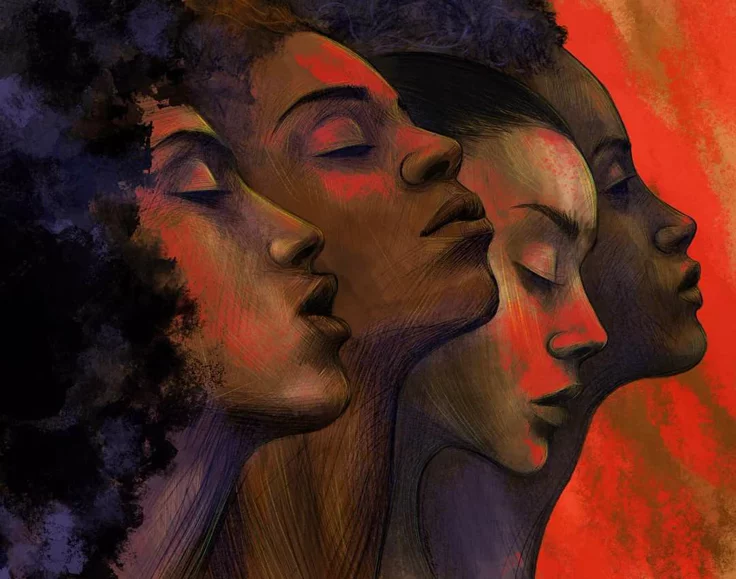
Illustration by Christian Paniagua
Being a mixed-race woman today: between stubborn stereotypes and the search for an identity you should never have to choose
There’s this question that keeps coming back. Endlessly. In the schoolyard, at a party, sometimes even at work. “Do you feel more Black or more white?”. As if you had to make a call. As if identity were a scratch card where you can only tick one box.
Growing up mixed-race often means growing up between two worlds. In Africa, you’re told you’re “too white.” In Europe, that you’re “too Black.” Not really from here, not really from there. A foreigner everywhere, at home nowhere or rather, at home on both sides at once, if you learn to live it that way.
Colorism : the problem we don’t name enough
In West Africa, the mixed-race woman often embodies a beauty “ideal” tied to her lighter skin. It’s both a perceived privilege and a cage. Cosmetics ads still promote skin-lightening products using light-skinned models as the only standard. The message is devastating: the lighter you are, the more beautiful you are. This colorism, discrimination based on skin tone within Black communities themselves, is one of the most toxic legacies of colonialism.
And then there are the stereotypes that cling. Mixed-race women are supposedly arrogant, too aware of their own “value.” You sometimes hear: “You’re different from other mixed girls.” As if that were a compliment. It’s mostly just a way of reducing thousands of women to a caricature.
In Europe: exoticism as a burden
On another side, in Europe, the challenges change shape but don’t go away. Here, people stop you to tell you that you look “exotic.” They try to place you — “Are you from the islands?” — as if a brown complexion couldn’t simply be French, Greek, Belgian or anything else, without a backstory to provide.
What these remarks reveal, even when well-meaning, is a deeply ingrained idea: it’s the white blood that “beautifies.” It’s the European part that “saves.” These thoughts are the direct aftermath of colonialism, and they still travel through people’s minds with a disconcerting sense of normalcy.
There are also less visible but very real forms of discrimination. Not putting your photo on a CV. Changing your name to “pass” more easily. Being told that a name that “sounds French” will make job hunting easier. This isn’t paranoia. It’s a documented reality.
In Greece: a double invisibility
Greece is a fascinating and complex place to be a Black or mixed-race woman. At the crossroads of African, Middle Eastern and European cultures, it carries a recent migration history, yet Black women remain largely absent from public life, local media, and politics. You can live here, work here, build a life here, and still feel like a ghost in the spaces that are supposed to reflect society back at you.
Whether they are immigrants, refugees, second-generation or expats, Black women in Greece face what can only be described as a double invisibility: being Black in a majority-white country and being a woman in a society where patriarchy is still deeply structural. Neither side of that equation is easy. It’s exhausting.
“I grew up here in Thessaloniki, I’m Egyptian-Greek mixed. People often ask me where I’m ‘really’ from, as if my presence here were temporary, or needed justifying.”
– Varvara, 29 years old, Thessaloniki
Greece hasn’t yet developed a strong political or media discourse around race and gender. The term “systemic racism” is barely used in the Greek public debate. That doesn’t mean the reality is absent, it means it’s still largely silenced, normalized, or ignored. And silence, as we know, has never protected anyone.
“People’s gaze can be warm, sometimes heavy. What’s missing is seeing yourself in ads, TV shows, newspapers. We’re here, but we don’t exist in society’s mirror.”
– Nadia, 28 years old, Thessaloniki
Even among well-integrated Black women – students, professionals, artists — the feeling of invisibility persists. Never seeing yourself represented in institutions, in the culture, in the stories a country tells about itself. And with the rise of far-right parties in recent years, many women from visible minorities feel less safe in certain public spaces, adding yet another layer of weight to simply existing.
Visibility for black women is necessary. In Greece, that visibility is still being built and they are building it, every day, on their own terms.
The intersection that complicates everything
Being a mixed-race woman means navigating the intersection of racism and sexism, what sociologist Kimberlé Crenshaw theorized under the term intersectionality. The two cannot be separated. A Black or mixed-race woman doesn’t experience racism the way a Black man does, nor sexism the way a white woman does. She lives both, simultaneously, with effects that multiply each other.
Add to that a specific set of stereotypes: the hypersexualization of the body, the myth of the “strong woman” who absorbs everything without ever breaking down, the perception of aggression the moment she speaks with conviction. American studies have even shown that Black women’s pain is systematically underestimated in medical settings, due to inherited beliefs about their supposed physical endurance. This isn’t ancient history. It’s happening now.
The question isn’t “do you feel more Black or more white?” The real question is: what’s stopping you from being both, fully, without having to justify it to anyone?
What’s changing and what we’re building
Things are shifting, slowly but surely. The natural hair movement, also known as the nappy movement, allowed millions of Black and mixed-race women to reclaim their textured hair, no longer as something to “tame” but as a beauty in its own, an act of cultural resistance. Figures like Anok Yai, an American model of South Sudanese origin with very dark skin, are breaking the single ideal of the light-skinned mixed woman as the only face of Black beauty.
Cartoons like Karma’s World, TV series, social media, all of it is creating spaces where Black and mixed-race women can finally see themselves: complex, whole, without owing anyone an explanation.
Because that’s really what representation is about. Not just seeing your face on screen. Seeing your complexity. Your doubts, your joys, your ambitions without your skin color being the only lens through which you’re read.
You don’t have to choose between two cultures, two countries, two identities. You can carry both, without hierarchy, without shame. That’s what it means to be mixed-race in 2026. A balance nobody hands you, one you build yourself, on your own terms.

