by Claudia L.
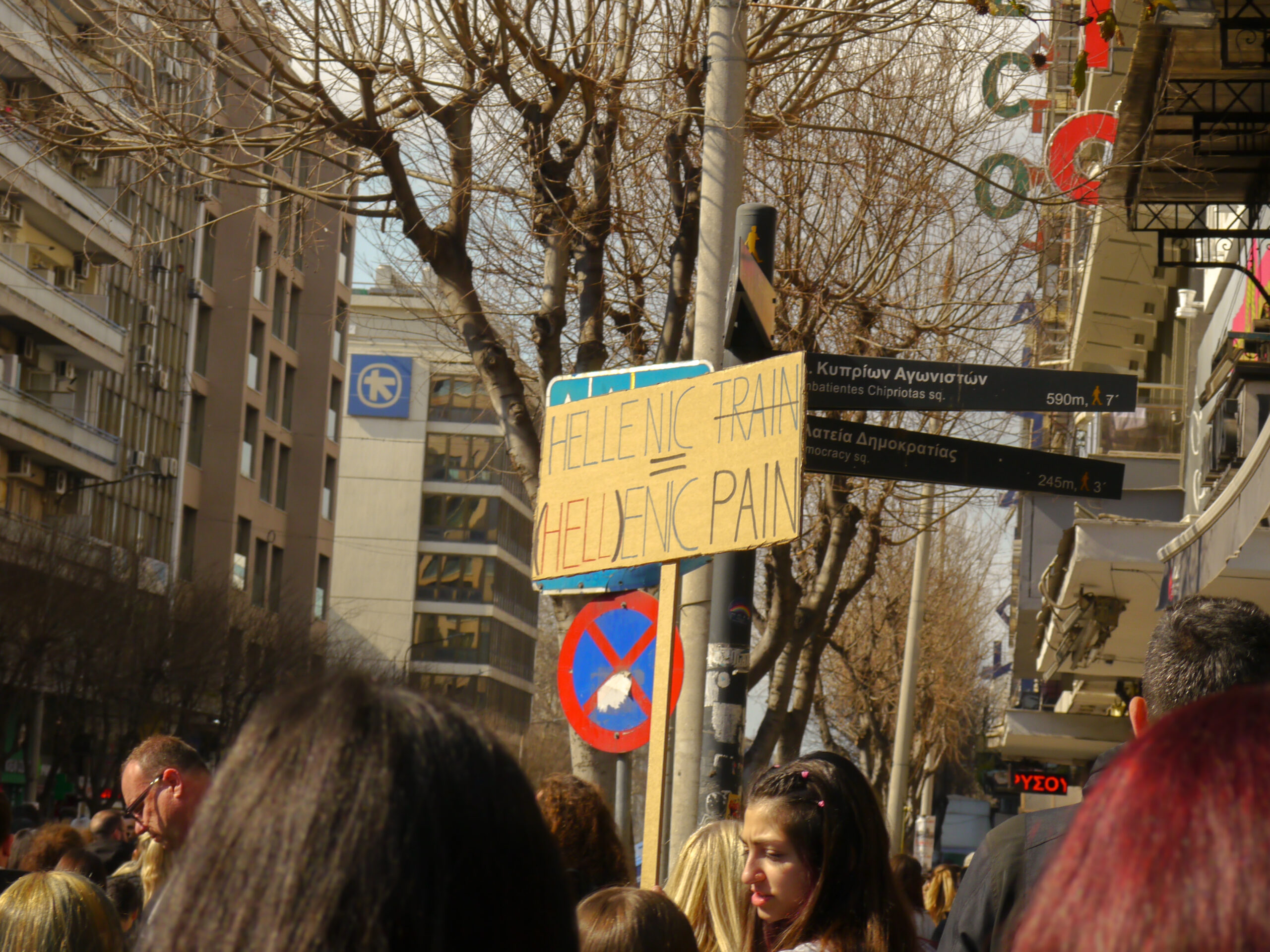
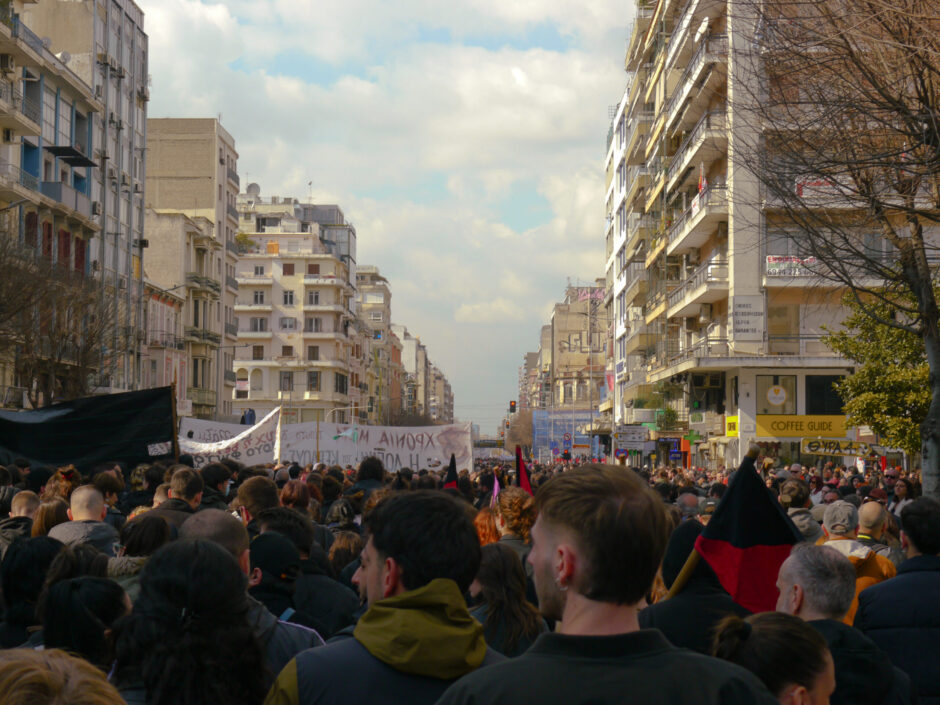
28th of February 2026, Archaia Agora Square, Thessaloniki, a huge crowd is gathering, waiting for the demonstration to begin.From the speakers, you can hear people taking the floor one by one. Then, you hear rap music – “Rebellion Connection – Giasemi – Afieromeno stin KOP feat Giorgios Mavroulis.” Definitely a political song for a super political event.
Three years ago, on the 28th of February 2023, 57 people died, hundreds got injured and the entire country wasshaken and horrified by one of the most deadly train crashes in Europe since 2000. A passenger train and a freight train carrying unknown substances collided because they were on the same railway for almost 20 minutes, without any alarm system triggering. The head-on collision resulted in a huge explosion. It happened in the Tempi valley, which is the name used to refer to the event. The train crash was followed by a rushed careless investigation from the Greek authorities. Worse, only a few days after the crash, cement was poured over the crime scene. Thus, it makes sense that people assume the government is hiding something, they are literally covering it. Every year since Tempi, many Greeks go on strike and attend the demonstration. In Thessaloniki, as in Athens, the metro and buses were stopped for the day.
As I’ve heard it in one of the many documentaries that were made, « the tempi crash was not only a tragedy for the people who lost someone or for the people who survived it, the entire Greek society was in shock and was mourning the deaths ».
When we, humans, are facing death and tragedies, we feel the need to gather. It seems to be a very natural thing. We do it all over the world for funerals, and to me, we do it the same way for political reasons : we walk for funeral processions, just like we walk for political demonstrations. Tempi is an example of how collective action emerges in response to disaster, unspeakable death, and injustice. People from opposite political parties find themselves side by side in the demonstration. During a football match, opposing teams shouted with one voice to denounce injustice, corruption and say it was a crime. Once again, you could hear “it was not an accident.” The phenomenon spread even outside the country. In January, after the train crash that happened in Spain, at a football match between a Greek and a Spanish team, you could read signs saying “Adamuz-Tempi different place, same tragedy”.
If you ask Greeks about Tempi, you will hear words like “crime, institutional mass murder, tragedy, disaster”. The words we choose have an impact on the kind of response it invites. Greeks know about this, as they claim “it was not an accident”; they are fighting against the government. Dr. Rim Saab warned about “the depoliticising effect of humanitarian language, which can erase responsibility and obscure systemic violence”. She gives the example of genocides, refusing to use the word “denies both victims experiences and the possibility of justice”. So the words we choose are fundamental, and from a “simple” tragedy we go to political struggle. “Tragedy”, “accident” to “crime, institutional mass murder”.
Before Tempi, Greece was already known for its “deadly rail tracks”. The 2023 train crash might represent the breaking point of Greek society. The violence of the crash, the explosion, the covering of the scene, the lack of answers from the government, in fact the global reaction of the authorities just highlighted the political issues of the country. Under these circumstances, there is little expectation that one day justice will be served. But seeing the massive responses from Greeks, witnessing the unity that horror created, being in the middle of the demonstration, it was a breath of hope. Let’s not lose faith in justice !

