Written by Gwendolyn Knorr and Charlotte Gumnior
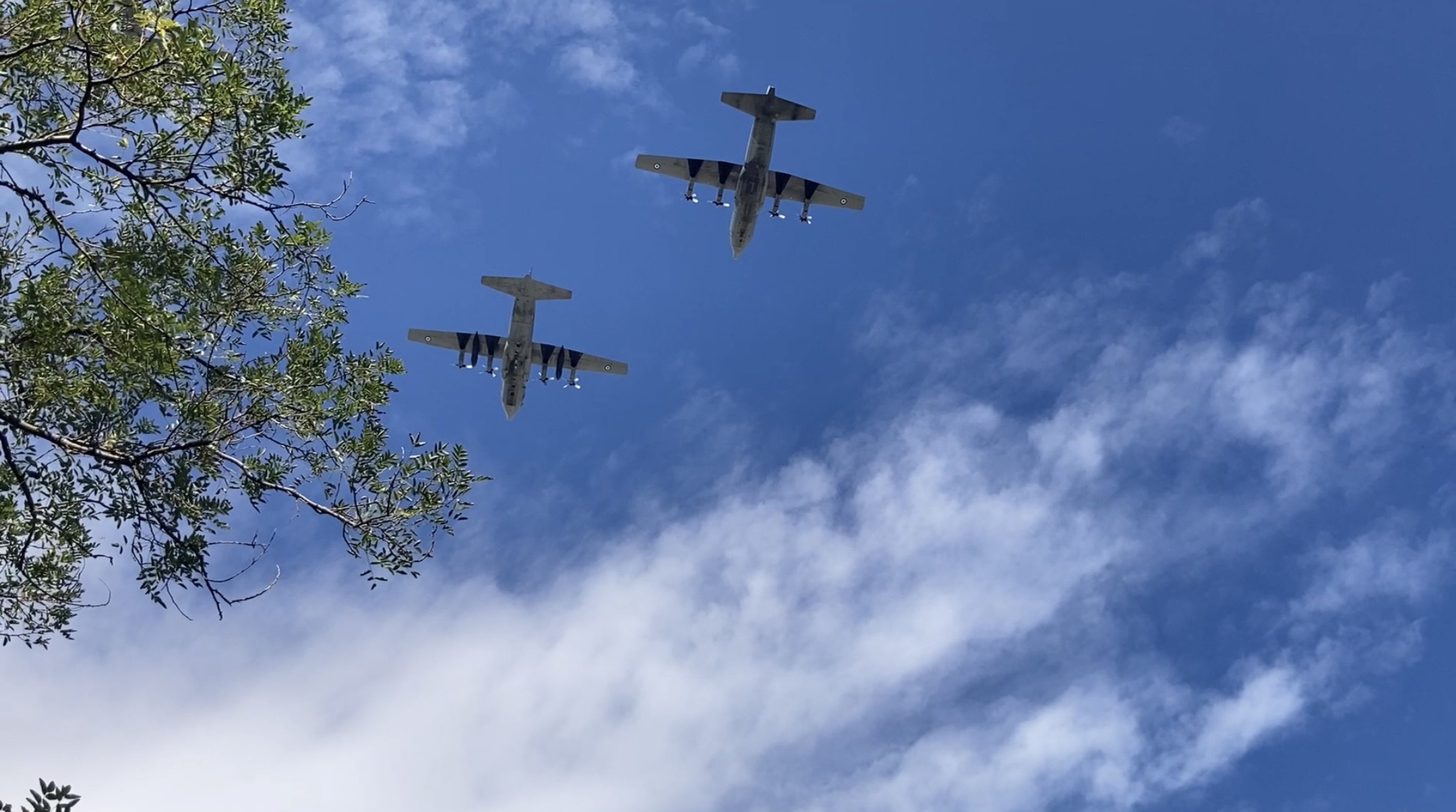
A little girl holding a Minion helium balloon is standing out of the crowd, sitting on her dad‘s shoulders. She’s blocking our view, but that doesn’t really matter. We can still hear the trumpets of the marching band, see the cloud of dust the tank left behind when it sped through the parade and watch the shadow of the military jet manoeuvre wander over the crowd.
A specific occasion must have caused these huge crowds of people to gather along Megalou Alexandrou Avenue…
and this occasion is the 85th anniversary of “Ochi Day“.
Now it’s been a while since we went to watch the parade.
Being new volunteers in Thessaloniki, this was the first Greek national holiday we had ever experienced.
As far as we learned from our “thorough” preparation for volunteering (a questionable Duolingo language course), “Ochi” means “No”.
So why are Greeks celebrating the “No” Day?
To answer this question, we have to go back 85 years in time to the period of the Second World War:
Up until the end of October 1940, Greece had not been involved.
However, at about 3 AM of the 28th of October, the Italian ambassador delivered an ultimatum from the dictator Benito Mussolini himself, a close ally of Hitler. He demanded from Greece to let Italy, and thereby the Axis powers, occupy unspecified “strategic points“; otherwise, he would declare war at 6 AM.
The Greek Prime Minister at the time, Ioannis Metaxas, decided to reject the ultimatum.
Allegedly, he answered with the single word “Ochi“ [No]; however, he actually replied with the French saying “Alors, c‘est la guerre“ [So, it‘s war].
“Ochi,” as a keyword for this occasion, was popularised by a newspaper headline reporting on their conversation.
Even 85 years later, on the 28th of October, Greek flags are raised, traditional songs are sung, wreaths are laid, houses are decorated and student and military parades, church services and family celebrations take place all across the country.
To fully experience this day, we decided to watch this year’s parade in Thessaloniki. Our expectations towards this celebration significantly differed from the reality we encountered. We mainly had imagined music, marching bands and traditional costumes – overall, a frisky atmosphere. That‘s why we were quite surprised when a big part of the parade focused on presenting Greece’s new military innovations.
The parade we encountered was composed of different parts. It started with students marching and a marching ensemble, followed by firefighter and military trucks driving down the street. Different military machinery was shown subsequently and tanks and fighter jets closed the parade.
In retrospect, we noticed that this celebration touched us more than we thought.
First of all, there was the impression of no longer being safe in the city. The presence of tanks and fighter jets during the whole morning made us uncomfortable and seemed alarming. As we had never experienced their presence in the context of a positive celebration before, we exclusively associated them with war and regions of crisis.
The speed at which the tanks drove through the masses made the ground tremble which felt intimidating and overwhelming, especially when the fighter jets simultaneously flew over the crowd.
Moreover, this impression of not being safe intensified into an episode of homesickness because we were missing the comfort, safety and silence of the streets at home.
On the other hand, this experience of seeing military equipment with our own eyes made us realise how grateful we are to live in peace. With these new impressions, the horrific images of war became more vivid than ever before. And our will to stand up for peace has intensified.
This perception of the parade made us wonder whether the powerful message of saying no to fascism must actually be underlined with military power, a tool of fascism?
As we were working on this very article and recalled our personal experience, we noticed that we were missing local perspectives, so we interviewed pedestrians on the streets of the city center. Even though many interviewees didn‘t have time to watch the parade this year, they did seem to care about the occasion itself and its historical importance.
When we asked them about the values they celebrate on this day, answers ranged from “the independence of Greece“ to “freedom“ and “resistance against other countries“. It was noticeable that priorities and opinions towards the military parade and the celebration of Ochi Day in general differ within the interviewed group, as well as what that day means to them.
While some people state that they like the tradition of the parade and the military taking part, others criticize that the expenses are too high and also the fact that school children take part in the parades. At the same time, core values being celebrated are Greece‘s military power, honouring what older generations fought for and keeping traditions alive.
This tradition of celebrating the anniversary of the „Ochi-Day“ already started in 1943, three years after Metaxas refused the ultimatum.
On that day, employees of the Greek National Bank held a memorial service in front of their headquarters in Athens. This commemoration was an open act of resistance in German-occupied Greece. About 20 people taking part in the memorial were arrested by German occupiers and sent to concentration camps.
For us, these military parades provoked a lot of thinking about the use and image of military and on the different views on this topic that might substantially differ depending on where you are from and your country’s historical connection to the military. Being German we might have a stronger aversion against anything related to military and national pride due to the responsibility to work through our history.
To us it seems contradictory to celebrate the country’s decision to stand up against fascism by presenting military machinery given the ambiguous nature of the symbol and the fact that military power is one of the tools that fascism uses to make people obey.
As we truly support the idea of standing up against fascism, we were wondering if education and commemoration could be a main or at least an additional mean to convey the core value of the day.

