
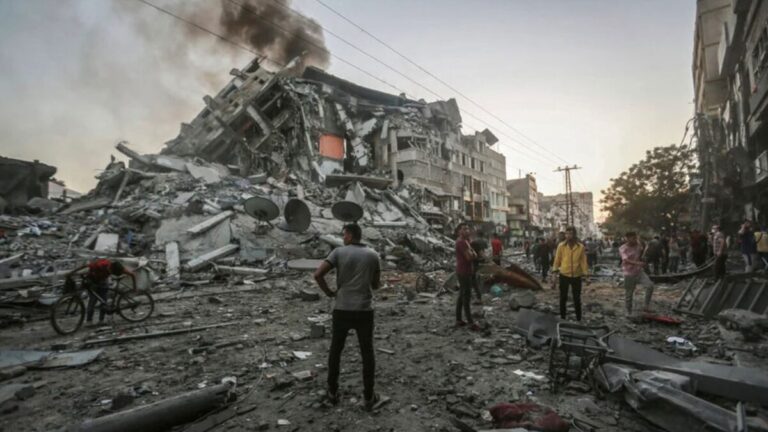
The text below continues A Chronicle of Erasure and Dispossession on Palestine, 1917–1967. For full context, it is best to read the text above first.
We left off at the Six-Day War of 1967, fifty years after the Balfour Declaration. By then, the Palestinian people were already navigating increasingly treacherous waters, following the great catastrophe (Nakba), the ethnic cleansing of two-thirds of the Palestinian population, and UN Security Council Resolution 242, which framed the conflict as a state-to-state dispute while erasing Palestinians as a political people, reducing them to a vague “refugee problem” and legitimizing Israel’s post-1967 occupation. At the same time, a decisive shift toward near-total U.S. alignment with Israel was beginning to take shape.
Yet oppression, erasure, dispossession, and repression did not end there. In fact, marking fifty years was not a conclusion, but another beginning, a trajectory that is now approaching sixty years.
We are speaking of generations of people who were wronged, displaced, and killed in the name of the Jewish project, often with the acquiescence of much of both Western and Eastern civilization.
One hundred and nine years of oppression and persecution.
Understanding history concerns us all.
.
.
.
The aftermath of the 1967 war
After the 1967 Six-Day War (Naksa), Israel occupied the West Bank, East Jerusalem, the Gaza Strip, the Sinai Peninsula, and the Golan Heights, displacing around 300,000 Palestinians, many of whom became refugees for a second time after the Nakba’s 1948 exodus. Israel established a military government over the occupied territories and began building settlements, seizing large areas of land in the West Bank and Gaza, and demolishing over 1,300 Palestinian homes by 1982. In the wake of the defeat, the Palestinian Liberation Organization (PLO), formed in 1964, became more independent and focused on armed struggle, with the 1968 Battle of Karama in Jordan marking a turning point that boosted its legitimacy. Following armed clashes with the Jordanian army in 1970–1971, known as Black September, the PLO was forced to relocate to Lebanon, where it established headquarters in Beirut and a strong military presence in South Lebanon, effectively creating a “state within a state” involved in the Lebanese Civil War.
Despite the occupation, Palestinian nationalist candidates aligned with the PLO won a major victory in the 1976 municipal elections in the West Bank. In 1982, Israel invaded Lebanon to dismantle the PLO, resulting in its expulsion to Tunisia and the Sabra and Shatila massacre, where Lebanese Christian militias allied with Israel killed over 3,000 Palestinians. Along with that, diplomatically, Egypt’s 1979 peace treaty with Israel removed the largest Arab military threat, allowing Israel to focus on Lebanon and the occupied territories, while by 1982 the Arab League began signaling support for a diplomatic, two-state solution.
By 1982, Beirutis were accustomed to war. On June 4, warplanes bombed West Beirut, targeting areas associated with the PLO. The invasion, directed by Israeli defense minister Ariel Sharon and approved by Prime Minister Menachem Begin, aimed to destroy the PLO’s military and political presence in Lebanon, expel Syrian forces, and reshape the regional balance. Although publicly described as a limited operation, it quickly escalated into a full-scale war involving over 76,000 Israeli troops. Within days, Israeli forces advanced to Beirut, encircled West Beirut, and began a devastating seven-week siege. Airstrikes and artillery fire flattened residential buildings, refugee camps, and entire neighborhoods. Water, electricity, food, and fuel were repeatedly cut off, and approximately 19,000 Lebanese, Palestinians, and Syrians were killed in the war. While Israel claimed to be targeting military infrastructure, many attacks appeared indiscriminate and aimed at breaking civilian morale. (See IDF’s interesting interpretation and rhetoric on the war)
Despite relentless bombardment, much of the PLO’s underground leadership survived. Diplomatically, however, the organization was isolated. The United States backed Israel and pressed for the PLO’s unconditional withdrawal, while Arab governments offered little concrete support. Under mounting military and political pressure, and following written assurances from U.S. envoy Philip Habib that civilians would be protected, the PLO agreed to evacuate Beirut in August 1982.
Between August 21 and September 1, thousands of PLO fighters departed. Shortly afterward, after U.S. peacekeeping forces withdrew prematurely, President-elect Bashir Gemayel was assassinated. Israeli forces then entered West Beirut despite prior assurances to Washington that they would not. Soon afterward, Israeli-backed Lebanese Forces militias entered the Sabra and Shatila refugee camps and massacred more than a thousand Palestinian and Lebanese civilians while Israeli troops surrounded the camps and illuminated them with flares. An Israeli commission later found Israeli leaders, including Sharon, indirectly responsible, though no one faced criminal punishment.
The invasion marked a watershed. It was the first major war centered primarily on the Palestinians rather than Arab state armies, and it reshaped Lebanon’s political landscape. The war intensified the Lebanese civil conflict, fueled the rise of Hizballah, and hardened anti-American sentiment across the region. Although the PLO was expelled from Lebanon, the Palestinian national movement eventually shifted back inside the occupied territories, contributing to the outbreak of the First Intifada in 1987. The war’s political, moral, and strategic consequences continue to reverberate.
1987 – The First Intifada
The Intifada war, which erupted in December 1987, was a powerful example of unintended consequences. When Ariel Sharon and Menachem Begin launched the 1982 invasion of Lebanon, their objective was to destroy the PLO and extinguish Palestinian nationalism in the West Bank and Gaza. Instead, although the war weakened the PLO’s external infrastructure, it strengthened Palestinian resistance within the occupied territories. After two decades of what Israeli officials had described as a manageable occupation, a mass grassroots uprising broke out in Gaza following a deadly traffic incident involving an Israeli vehicle and Palestinian laborers, and it quickly spread throughout the West Bank. What began as spontaneous protests evolved into a sustained, locally organized revolt rooted in neighborhoods, villages, and refugee camps.
The uprising developed an extensive network of popular committees and a clandestine Unified National Leadership that coordinated strikes, boycotts, tax resistance, and demonstrations. Although clashes sometimes turned violent, the intifada was predominantly civic and unarmed, enabling wide participation across Palestinian society, students, workers, professionals, merchants, and especially women, who assumed major leadership roles as many men were imprisoned. The revolt demonstrated that opposition to occupation was deeply embedded in society and not confined to exiled factions.
Israel’s response was severe. Defense Minister Yitzhak Rabin ordered troops to use “force, might, and beatings,” inaugurating an “iron fist” policy marked by systematic repression. Images of heavily armed soldiers confronting stone-throwing youths were broadcast worldwide, eroding Israel’s international standing and reshaping global perceptions of the conflict. Between 1987 and the mid-1990s, more than a thousand Palestinians were killed, many of them minors, while Israeli casualties were significantly lower. The prolonged unrest imposed tangible security, economic, and reputational costs on Israel and underscored the unsustainability of indefinite occupation. The communiqués set out political, social, economic, and cultural priorities (sometimes, in the case of general strikes, directives). Most groups opposed to Yasir Arafat and the mainstream PLO likewise joined in the resistance. The Muslim Brotherhood, hitherto devoted to activities centered on family life and religious ritual, created a militant wing, Hamas (acronym for the Islamic Resistance Movement), which became increasingly involved in the uprising, issuing its own communiqués, only sometimes concordant with those of the UNLU.
Politically, the intifada transformed the Palestinian national movement. It shifted the center of gravity from the PLO leadership in exile to those living under occupation and generated unprecedented international sympathy. In 1988, the PLO formally accepted a two-state framework, recognized Israel, and renounced terrorism in hopes of opening a diplomatic channel with Washington. Yet its position weakened after the 1990-91 Gulf War, when Yasser Arafat’s alignment with Iraq alienated Gulf states and reduced financial and political support.
When the Madrid peace conference convened in 1991 under U.S. sponsorship, Palestinians entered negotiations from a diminished position. Core issues, Jerusalem, refugees, settlements, sovereignty, and statehood, were deferred to a later “final status” phase, while Israel continued expanding settlements. Although the administration of George H. W. Bush briefly pressured Israel by withholding $10 billion in loan guarantees from the government of Yitzhak Shamir, sustained leverage was lacking. After Secretary of State James Baker’s departure, U.S. policy under Bill Clinton increasingly reflected the perspectives of officials such as Dennis Ross and Martin Indyk, who tended to treat Israeli red lines as the outer boundary of American diplomacy.
On the Israeli side, Yitzhak Rabin rejected meaningful Palestinian sovereignty, offering instead limited autonomy while retaining control over security, borders, land, and resources. Palestinian negotiators proposed more substantive interim arrangements, but internal tensions between leaders in Tunis and representatives from the occupied territories weakened their position. Frustration with the stalled public talks led Rabin and Yasser Arafat to authorize secret negotiations that culminated in the 1993 Oslo agreement. Oslo established mutual recognition but deferred decisive issues and preserved Israeli dominance on the ground. The 1995 Oslo II accord divided the West Bank into Areas A, B, and C, leaving most territory under full Israeli control while granting the Palestinian Authority limited administrative powers and responsibility for security coordination.

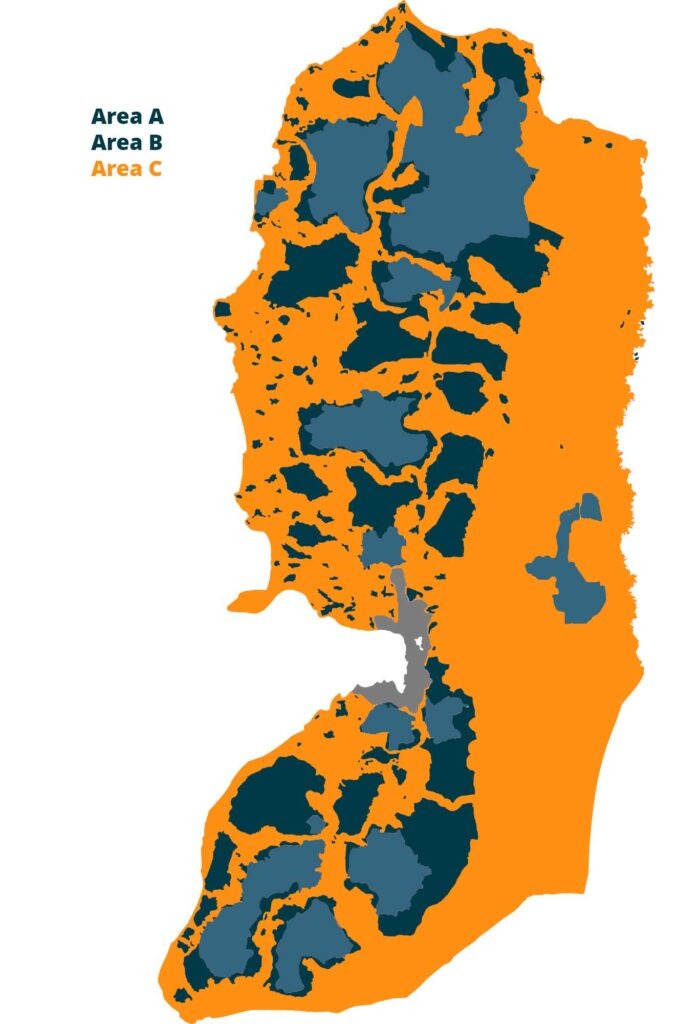

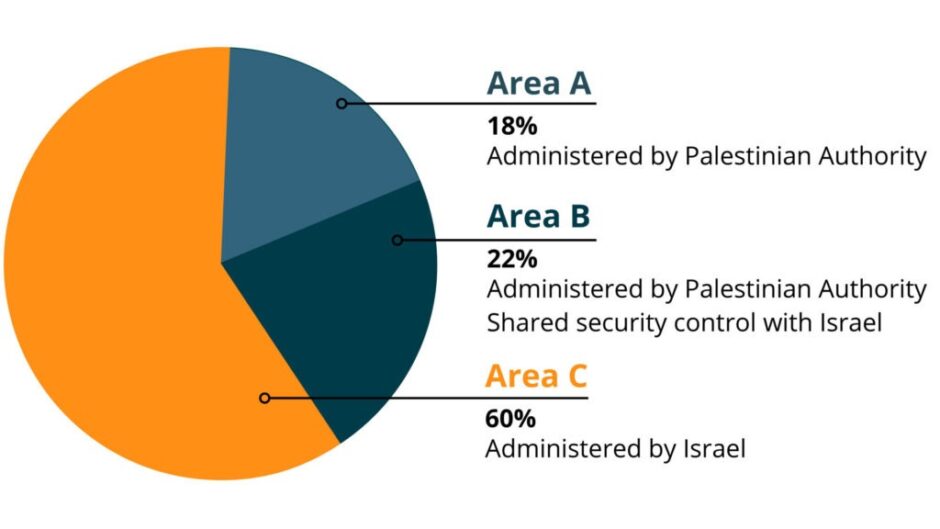
Rather than ending the occupation, the Oslo process restructured it. Israel reduced the visible burdens of direct rule while maintaining ultimate authority over borders, movement, resources, and settlements, which continued to expand. The Palestinian Authority exercised constrained self-rule without sovereignty. What emerged was not a clear transition to independence but a modified system of control sustained by ongoing Israeli policies and consistent American political and diplomatic backing.
2000 – Now
For many Palestinians, disillusionment with the Oslo process set in almost as soon as the 1993 signing ceremony concluded. The hopeful language of mutual recognition between Israel and the PLO quickly collided with realities on the ground. Rather than freezing settlement activity, Israeli governments accelerated it. The West Bank became increasingly fragmented by bypass roads, checkpoints, military zones, and expanding settlement blocs, while Gaza was progressively sealed off from both Israel and the West Bank. East Jerusalem, long the economic and cultural heart of Palestinian life, was further isolated. Although a small circle connected to the newly created Palestinian Authority gained positions and limited privileges, most Palestinians experienced declining living standards, restricted movement, and a growing sense that autonomy without sovereignty was entrenching, rather than ending, occupation.
These conditions strengthened Hamas, which had emerged during the First Intifada as an Islamist alternative to the secular PLO. Presenting itself as less corrupt and more committed to resistance, Hamas gained credibility as negotiations stalled. The collapse of the 2000 Camp David summit marked a turning point. Israeli Prime Minister Ehud Barak and U.S. President Bill Clinton publicly blamed Yasser Arafat for rejecting what they described as a far-reaching offer, while Palestinians argued that the proposal fell short of genuine sovereignty. Mutual recriminations deepened mistrust, and when Ariel Sharon visited the Haram al-Sharif/Temple Mount in September 2000, protests erupted into the Second Intifada.
Unlike the largely unarmed First Intifada, the second uprising was far more militarized. Palestinian armed groups carried out suicide bombings inside Israeli cities, killing hundreds of civilians. Israel responded with overwhelming force, targeting assassinations, large-scale incursions, the 2002 reoccupation of major West Bank cities, and the construction of a separation barrier cutting deep into West Bank territory. Arafat was besieged in his Ramallah headquarters until his death in 2004. The human toll was devastating; thousands of Palestinians and Israelis were killed, but the strategic consequences weighed heavily on Palestinians. Israeli public opinion hardened, support for territorial compromise declined, and Palestinian institutions and the economy suffered severe damage.
After Arafat’s death, Mahmoud Abbas assumed the presidency of the Palestinian Authority, advocating nonviolence and renewed diplomacy. Yet his authority was limited, and internal divisions deepened. In 2006, Hamas won a surprise victory in Palestinian legislative elections, reflecting frustration with Fatah’s governance and the stagnation of negotiations. The result triggered international sanctions and an escalating confrontation between Hamas and Fatah. In 2007, Hamas seized control of Gaza, leaving the Palestinian polity divided between a Hamas-ruled Gaza Strip and a Fatah-dominated Palestinian Authority in the West Bank.
Israel imposed a comprehensive blockade on Gaza, severely restricting the movement of goods and people. Over the following years, repeated wars, in 2008-09, 2012, 2014, and subsequent escalations, inflicted heavy civilian casualties and widespread destruction. Hamas rocket fire into Israel, though far less lethal than Israeli airpower, reinforced cycles of retaliation and justified continued Israeli military operations in the eyes of much of the Israeli public. Each round of violence deepened humanitarian suffering and political paralysis, while reconstruction lagged and living conditions in Gaza deteriorated further.
Diplomatically, the peace process steadily lost credibility. Negotiations resumed intermittently but without meaningful progress on core issues, borders, Jerusalem, refugees, settlements, and security. Settlement growth continued, and the territorial contiguity envisioned for a Palestinian state eroded. The Palestinian Authority increasingly functioned as an administrative body under occupation, responsible for governance and security coordination but lacking sovereignty. Critics argued that the post-Oslo framework had shifted the burden of daily management onto Palestinians while leaving ultimate control in Israeli hands.
In the United States, bipartisan political support for Israel remained strong, though public opinion, particularly among younger Americans and segments of the Democratic Party, grew more critical of Israeli policies. Many of the hopes invested in President Barack Obama rested on the mistaken belief that American presidents possess unlimited freedom of action. In reality, even a determined executive confronts the entrenched influence of the national security bureaucracy and the pro-Israel lobby, with no comparable counterweight advocating effectively for Palestinian rights. Early optimism accompanied Obama’s appointment of George Mitchell as special envoy in 2009. Mitchell, known for helping broker the 1998 Good Friday Agreement, appeared willing to challenge settlement expansion and address core final-status issues. Yet he was undermined by internal rivalries, including the prominent role of Dennis Ross, and by resistance from Congress and Israeli Prime Minister Benjamin Netanyahu. Mitchell resigned in 2011, and the status quo endured.
Although tensions between Obama and Netanyahu were sometimes visible, U.S. policy fundamentals remained unchanged. Military aid continued, and efforts by Secretary of State John Kerry to revive negotiations failed. A late abstention allowing passage of UN Security Council Resolution 2334 condemning settlements had little practical effect. The broader lesson was that when Obama considered an issue, such as the Iran nuclear agreement, a vital American interest, he was willing to expend political capital; Palestine did not receive comparable priority.
Under President Donald Trump, even the appearance of neutrality faded. His first term administration recognized Jerusalem as Israel’s capital, moved the U.S. embassy, recognized Israeli sovereignty over the Golan Heights, cut aid to the Palestinians and to UNRWA, and closed the PLO mission in Washington. Envoys such as David Friedman and Jared Kushner advanced a “deal of the century” that envisioned a fragmented, non-sovereign Palestinian entity while consolidating Israeli control over key territories. Washington functioned less as a mediator than as an advocate for Israeli positions.
These developments coincided with shifting regional alignments, as several Gulf states deepened cooperation with Israel, even while Arab public opinion remained broadly sympathetic to the Palestinian cause. Meanwhile, global power balances evolved, with Europe, Russia, China, and India expanding their roles in the Middle East. Yet none displaced the centrality of U.S. influence.
Since October 7, 2023, and following Hamas’ attack, the war has taken a new turn. From Biden’s presidency to Trump’s second term, the war reached dimensions of genocide. This particular event seems to have taken most of the blame for the general outbreak of war, while it is also the most well-known event in this conflict-ridden relationship between Palestine and Israel. I will not elaborate further on this incident, as I believe the situation is clear enough as to what this war means for the Palestinian and Israeli people, what the division of deaths means, the attacks that were caused by each side, and under what circumstances they took place.
A century and nine years after the Arthur James Balfour Declaration dismissed the political aspirations of Palestine’s Arab majority, and decades after war and occupation reshaped the land, Palestinians remain politically constrained but nationally resilient. Despite exile, fragmentation, and profound asymmetry of power, they continue to assert their presence and rights. The conflict endures not simply because of irreconcilable identities, but because of entrenched inequalities embedded in law, territory, and political structures. Any durable resolution must therefore rest on genuine equality, civil, political, and national, for both peoples between the Jordan River and the Mediterranean Sea. Without that foundation, diplomatic initiatives and economic inducements are likely to manage the conflict rather than resolve it.
We are witnessing a sophisticated and systematic effort of erasure, denial of rights, refusal of recognition, and dissemination of propaganda, not only by the Israeli state but by the broader Western political and cultural apparatus, against Palestine.
Erasing the past extinguishes the aspirations for return, equality, and restitution that remain vital to Palestinian claims. Historical knowledge is the foundation for accountability, resistance, and envisioning a future where rights, dignity, and justice are restored. To forget the past is to forfeit the possibility of a just future; to remember it is to keep alive the claims and hopes of a people denied their homeland.
.
.
.
.
.
.
The text is based on the historical facts, views, and insights presented in Rashid Khalidi’s The Hundred Years’ War on Palestine.
Further elaboration on the subject is of vital importance for all of us.
Below, I provide some books, articles, videos, and Instagram accounts from which I consider the information particularly significant.
Books
- The Hundred Years’ War On Palestine*
- On Palestine*
- Moral Abdication
- Perfect Victims and the Politics of Appeal
- Ethnic Cleansing of Palestine*
- Ten Myths About Israel*
- Palestinian Identity*
- Under Siege: P.L.O. Decisionmaking During the 1982 War
- The Secret Life of Saeed: The Pessoptimist*
- Men in the Sun and Other Palestinian Stories*
Articles
- More than a century on: The Balfour Declaration explained
- Israeli Routes Through Nakba Landscapes: An Ethnographic Meditation
- The Nakba in Israeli history education: Ethical judgments in anongoing conflict
- A Trip To Palestinian Reality
- A Chronicle of Erasure and Dispossession on Palestine, 1917–1967
Videos
- Rashid Khalidi: This genocide ‘worse than any phase of Palestinian history’
- Palestine 1920: The Other Side of the Palestinian Story | Al Jazeera World Documentary*
- How Israel Won the West | The Big Picture*
- Al-Nakba: 70 years of exile | Al Jazeera News Special*
- Ilan Pappé: The Untold Truths of the 1948 Palestinian Nakba
- How Palestinians were expelled from their homes
- The Balfour Declaration explained
- Whose Land Episode 2 – Ottoman Turkish rule over Palestine
- Whose Land Episode 3 – The Zionist Movement and the Balfour Declaration
- Whose Land Episode 14 – UN Security Council Resolution 242
- Stories From the Intifada (Part 1) – Al Jazeera World
- PLO: History of a Revolution – Intifada – 10 Aug
- President Donald Trump Recognizes Jerusalem As Israel’s Capital | CNBC
IG accounts

