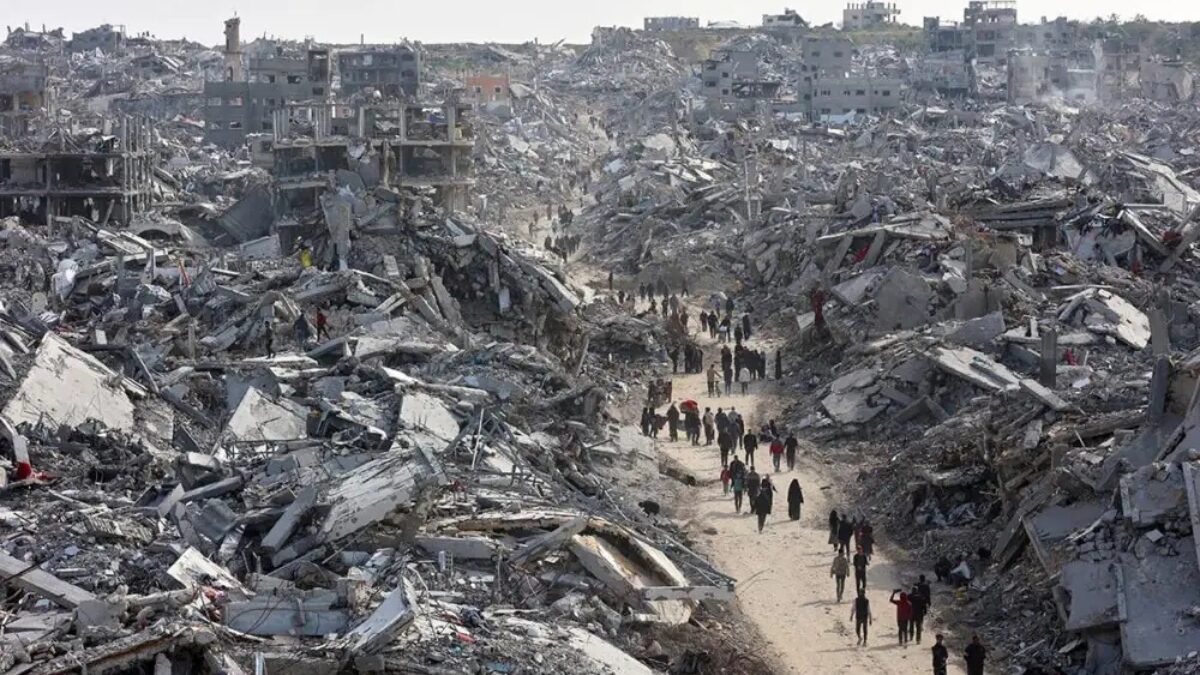
On November 2nd, 1917, the British government issued a declaration that purported to uphold two incompatible principles. In a letter from Foreign Secretary Arthur James Balfour to Lord Rothschild, Britain expressed its support for the establishment of a national home for the Jewish people in Palestine:
“His Majesty’s Government view with favour the establishment in Palestine of a national home for the Jewish people, and will use their best endeavours to facilitate the achievement of this object, it being clearly understood that nothing shall be done which may prejudice the civil and religious rights of existing non-Jewish communities in Palestine, or the rights and political status enjoyed by Jews in any other country.”
The ambiguity of this formulation, granting collective national rights to one population while reducing the other to individual civil and religious protections, would have far-reaching consequences.
One hundred and nine years later, this very declaration, known as the Balfour Declaration, is widely regarded as the starting point of one of the most tragic and protracted conflicts in modern history.
.
.
.
We are in the midst of the First World War, a period of profound crisis and one of the deadliest conflicts in modern history. The Middle East constituted a major theatre of this war, and the decline of the Ottoman Empire (a long stabilizing force in the regional order) produced significant geopolitical disruptions. For centuries, Palestinians had lived under Ottoman rule, where political identity was shaped primarily by religion, family, and locality rather than by modern nationalism. The war destabilized this system and accelerated the spread of nationalist ideas, particularly those centered on self-determination. By late 1917, the wider conflict had reached a stalemate, with British troops having captured Jerusalem. By 1989, they had occupied the whole country. Britain, which had begun considering the future of Palestine early in its war against the Ottoman Empire, approved the final version of the Balfour Declaration on October 31, 1917.
British thinking regarding Palestine was closely connected to what contemporaries often described as the “Jewish question.” Longstanding philosemitic and biblical ideas, which framed Jewish settlement in Palestine as a return to the “land of the Bible” combined with domestic concerns about limiting Jewish immigration to Britain. At the same time, Palestine held substantial strategic value within Britain’s imperial system. The sum of these considerations shaped the declaration, which ultimately reflected British imperial priorities rather than the political realities of the local population.
For Palestinians, the declaration was widely perceived as an escalation of the Zionist movement’s ambitions in their homeland. The document explicitly supported the establishment of a national home for the Jewish people, while offering only a vague assurance that “nothing shall be done which may prejudice the civil and religious rights of existing non-Jewish communities in Palestine”, a commitment that was not translated into binding political guarantees or effective policy.
Palestinians organized politically to oppose British rule and the privileges extended to Zionist institutions in response to the declaration. Between 1919 and 1928, a series of Palestinian Arab Congresses called for independence, majority rule, rejection of the Balfour Declaration, and restrictions on Jewish immigration and land acquisition. British authorities consistently rejected these demands, refusing to recognize Palestinian representative bodies unless they accepted the Mandate system and the Balfour Declaration itself. The declaration’s language and its near-total omission of Palestinians as a political people contributed to their systematic marginalization within the emerging political framework.
This inequality was formally entrenched with the League of Nations Mandate for Palestine in 1922. The Mandate incorporated and expanded the Balfour Declaration, granting collective national rights exclusively to the Jewish people while denying Palestinians recognition as a people entitled to political self-determination. Through the Jewish Agency, Zionist institutions were granted quasi-state authority over immigration, land settlement, education, economic development, and international representation. In contrast, the Arab majority was denied democratic institutions and meaningful self-government. In practice, a Zionist para-state developed under British protection, while Palestinians were confined to a legal status defined largely by individual and religious rights.
As a result, Jewish immigration increased substantially during the 1920s and 1930s, particularly after 1933 with the rise of Nazi persecution in Germany. Supported by significant capital investment, this influx altered Palestine’s demographic and economic balance. By 1939, Jews constituted more than 30 percent of the population, and their economy had surpassed the Arab sector. Palestinians increasingly experienced displacement through land transfers and exclusion from political and economic power, fostering a growing sense of dispossession.
Resistance developed as a result of these changes. Early opposition took the form of petitions, demonstrations, strikes, and periodic unrest during the 1920s. By the early 1930s, younger and more radical Palestinians began forming armed networks, including those associated with Shaykh Izz al-Din al-Qassam and the Istiqlal Party. British administration relied heavily on repression, censorship, and divide-and-rule strategies, including the manipulation of internal Palestinian rivalries and the promotion of institutions that emphasized religious identity over national cohesion.
These tensions culminated in the Great Palestinian Revolt of 1936–1939, the central conflict of the Mandate period (~1920-1948). It began with a six-month general strike, among the longest in colonial history, and developed into a large-scale armed uprising against British rule and Zionist expansion. The revolt was a mass, grassroots movement shaped by years of political exclusion, economic dispossession, and unfulfilled promises. Britain responded with overwhelming force, deploying tens of thousands of troops, conducting aerial bombardments, enforcing collective punishments, carrying out executions and demolitions, and arresting or exiling much of the Palestinian leadership.
The revolt was ultimately suppressed at a devastating cost. Approximately 10 percent of the adult male Palestinian population was killed, wounded, imprisoned, or exiled, leaving Palestinian society fragmented, leaderless, and economically weakened. In contrast, Zionist institutions emerged stronger, better armed, and more cohesive, having benefited directly from British military support during the suppression of the uprising. Although Britain issued the 1939 White Paper promising limits on immigration and eventual self-government, these commitments were only partially implemented. By the outbreak of the Second World War, Palestinian society was deeply debilitated and unable to mount coordinated resistance.
As a consequence of all this, the balance of power in Palestine shifted decisively. The institutional foundations of a Jewish state were firmly established, while Palestinians had been systematically denied the right to self-determination. The developments of 1917–1939, particularly the Mandate system and the crushing of the Arab Revolt, played a decisive role in shaping Palestine’s political trajectory long before the catastrophe of 1948.
1948 – Nakba / Birth of the Israeli State
After the Second World War, global power relations shifted significantly. Britain’s imperial influence declined, while the United States and the Soviet Union emerged as the dominant international actors. Both supported the establishment of a Jewish state in Palestine, albeit for differing strategic, political, and ideological reasons. Palestinians, in contrast to the Hebrews, lacked effective international sponsorship and were largely excluded from diplomatic decision-making, including the United Nations process that culminated in the 1947 partition plan. At the regional level, the newly established Arab states were divided by rivalries, competing interests, and continued dependence on former colonial powers, conditions that prevented the formation of a coordinated and effective strategy in support of Palestine.
When violence intensified in late 1947 and developed into full-scale war in 1948, Zionist forces were already comparatively well organized, trained, and equipped, having benefited from years of institutional development, external support, and military experience. The outcome was the rapid disintegration of Palestinian society alongside the establishment of the State of Israel. Mass displacement, widespread loss of land and property, and the effective denial of Palestinian political and national rights accompanied this process. Approximately 750,000 Palestinians, around half of the Arab population of Palestine, were expelled or forced to flee amid extensive violence carried out by Zionist forces and, following statehood, by the Israeli army. Hundreds of towns and villages were depopulated, many of them destroyed or repopulated and renamed. By the end of the war, Israel exercised control over the majority of the territory of former Mandatory Palestine. Zionism increasingly functioned as the ideological infrastructure of the Israeli state, legitimizing territorial expansion, demographic control, and the exclusion of Palestinians.

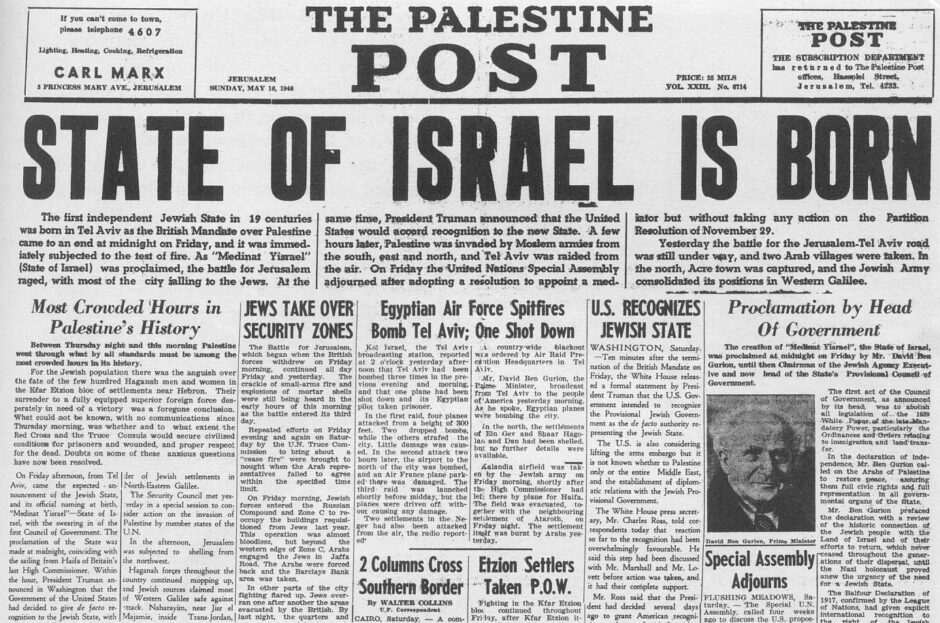
The Palestine Post, May 16, 1948 – “State of Israel Is Born”

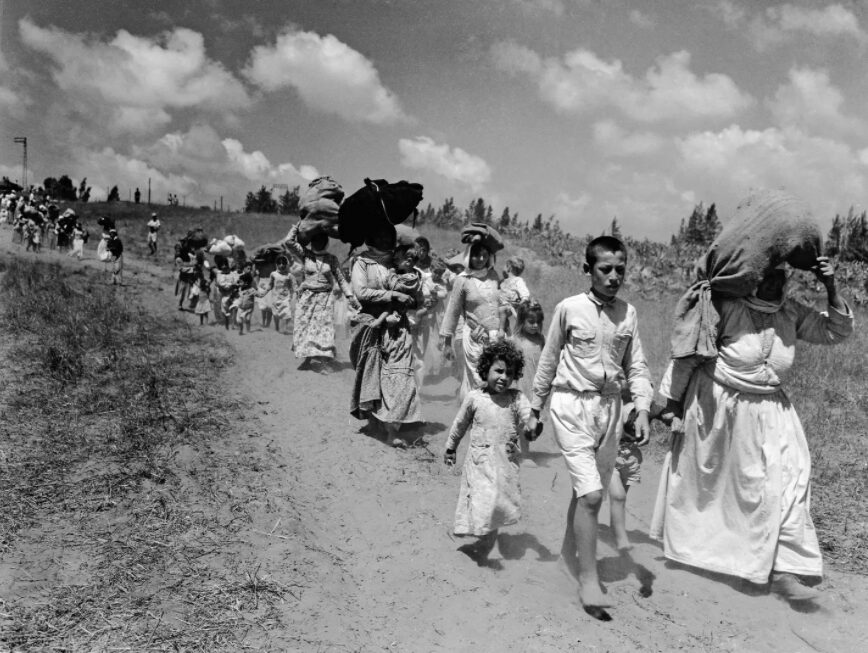
Palestinian refugees during the 1948 exodus
These events became known as the Nakba (meaning ‘the catastrophe’ in Arabic) and remain a foundational collective trauma shaping national identity and political claims for the Palestinians. Dominant Israeli narratives, however, have largely framed these same events as part of a war of independence, often minimizing or rejecting responsibility for Palestinian displacement and ethnic cleansing. Although critical scholarship has increasingly challenged this interpretation, it has not fundamentally altered official state narratives.
Palestinians who remained within Israel became a marginalized minority governed under military rule until 1966, facing land expropriation, restrictions on movement, and systematic discrimination within a state defined primarily in Jewish national terms (see Nakba and Survival by Adel Manna). Palestinian refugees outside Israel experienced divergent conditions depending on their host countries. In Jordan, most were granted citizenship, though tensions with the Hashemite monarchy persisted and eventually lead to armed confrontation. In Lebanon, Palestinians were welcomed in the beginning, as their displacement was viewed as temporary, although things changed a lot over the years, and after 1958, Palestinians lived under extreme restrictions in all aspects. In Syria, they achieved relatively higher levels of social and economic integration without the corresponding political rights (see Palestinians in Syria by Anaheed Al-Hardan)

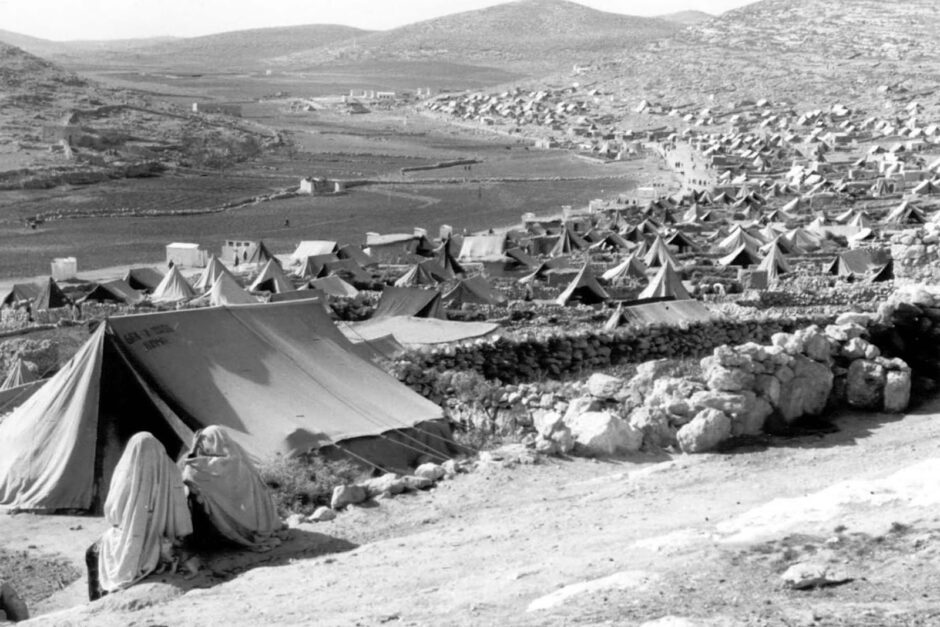
Refugee Camps, 1951
Despite their varying degrees of integration, Palestinians across different contexts shared a common experience of dispossession and political exclusion. Arab governments publicly endorsed the Palestinian cause but generally avoided sustained confrontation with Israel, constrained by military limitations and international pressure. Consequently, Palestine often functioned as a rhetorical symbol within inter-Arab politics, while Palestinians themselves remained largely unrepresented in international forums. Early efforts to establish independent Palestinian political organizations proved ineffective. The Arab states sought to manage said vacuum, rather than to dispense with it.
Over time, Palestinian political activism began to re-emerge. In the early 1950s, small armed groups initiated cross-border raids against Israel, motivated by the belief that Palestinians needed to reassert agency over their own struggle. Although limited in scale, these actions prompted severe Israeli retaliation and contributed to rising regional tensions. Israel increasingly adopted a doctrine of overwhelming force, launching large-scale attacks against Palestinian communities and neighboring Arab states, particularly in Gaza, where refugee populations bore the brunt of repeated military operations.
These developments contributed to the outbreak of the 1956 Suez War, during which Israel, Britain, and France launched a coordinated attack on Egypt. Although Israel achieved significant military gains, pressure from the United States and the Soviet Union compelled a withdrawal. Gaza, however, experienced substantial civilian casualties during the period of Israeli occupation, reinforcing its role as a focal point of Palestinian resistance. The crisis demonstrated that even weakened forms of Palestinian resistance could destabilize regional politics and draw in major international powers.
In the years that followed, Palestinians remained politically constrained by both Israeli policies and Arab state control, yet their commitment to resistance persisted. From conditions of displacement, repression, and recurrent military violence emerged new political organizations and leaderships that would later shape the modern Palestinian national movement. However fragmented and dispersed, Palestinians continued to challenge a regional order structured against them, often at considerable human cost, laying the groundwork for further confrontation in the decades that followed.
1967- The Six-Day War
Israel’s preemptive strike in 1967, launched with US approval, resulted in the occupation of the Sinai, Gaza, the West Bank, East Jerusalem, and the Golan Heights, and marked a decisive shift toward near-total US alignment with Israel. US and Israeli military assessments before and after the war confirmed Israel’s overwhelming superiority, yet narratives of danger persisted to justify unconditional American support. This alignment was institutionalized through UN Security Council Resolution 242, which framed the conflict as a state-to-state dispute while erasing Palestinians as a political people, reducing them to a vague “refugee problem,” and legitimizing Israel’s post-1967 occupation.
Paradoxically, while 242 deepened Palestinian dispossession, it also catalyzed the revival of Palestinian national consciousness. After 1967, the Palestine Liberation Organization (PLO) and affiliated movements emerged as independent actors beyond Arab state control, achieving significant diplomatic visibility and cultural influence through figures such as Ghassan Kanafani, Mahmoud Darwish, and Edward Said. That said, these gains had sharp limits. The PLO consistently failed to prioritize diplomacy and public engagement, particularly in the United States and Israel, allowing Israel and its supporters to dominate international discourse by equating “Palestinian” with “terrorist.” Despite repeated warnings from Palestinian-American intellectuals, the PLO leadership, especially Yasser Arafat, focused more on inter-Arab maneuvering than on shaping Western public opinion.
As the PLO’s visibility grew, it faced fierce military and political countermeasures. Israel, often with explicit US backing, carried out raids, assassinations, and large-scale attacks across Jordan and Lebanon, while Jordan’s crushing of the Palestinian movement in 1970–71 (Black September) and Syria’s later intervention in Lebanon further weakened it. These pressures culminated in the Lebanese civil war, during which Palestinian refugee camps were besieged and massacred, often with Israeli support of local militias. The US, driven by Cold War priorities and its effort to pry Egypt away from the Soviet Union, consistently worked to marginalize the Palestinians, endorsing frameworks that excluded the PLO while covertly tolerating or enabling violence against it.
Meanwhile, Palestinian political objectives evolved under these constraints. The PLO moved from the maximalist vision of reversing Zionism and restoring an exclusively Arab Palestine, articulated in its 1964 National Charter, toward advocating a single democratic state for Jews and Arabs, and eventually toward acceptance of a two-state solution alongside Israel. These shifts represented major ideological transformations that acknowledged Israeli Jewish permanence, yet they gained little traction internationally. Opponents continued to cite the obsolete charter, while the PLO’s leadership failed to communicate its evolving positions effectively. Ultimately, acceptance of a two-state framework based on Resolution 242 trapped the Palestinians in a familiar dilemma: international recognition required acceptance of a formula that denied their core national aspirations.
The dispossession of the Palestinian people was not only a consequence of Israeli state formation but also a constitutive force in shaping Israeli power, US Middle East policy, and regional politics. While Palestinian resistance achieved moments of cultural and diplomatic recognition, sustained military repression, strategic US-Israeli alignment, and the structural exclusions embedded in Resolution 242 ensured that Palestinian self-determination remained deferred, even if Palestine itself could no longer be erased from history or global consciousness.
.
.
.
One hundred and nine years after the official letter from Britain’s cabinet, the war in Palestine not only continues but has, tragically, reached dimensions of genocide. The most recent colonial attempt in modern history is embodied in the protracted and tragic project of the Jewish state, which, as the above letter states, sought a national home. The outcome, of course, has taken a most devastating and violent turn for the Palestinian people.
We are witnessing a sophisticated and systematic effort of erasure, denial of rights, refusal of recognition, and dissemination of propaganda, not only by the Israeli state but by the broader Western political and cultural apparatus, against Palestine.
Erasing the past extinguishes the aspirations for return, equality, and restitution that remain vital to Palestinian claims. Historical knowledge is the foundation for accountability, resistance, and envisioning a future where rights, dignity, and justice are restored. To forget the past is to forfeit the possibility of a just future; to remember it is to keep alive the claims and hopes of a people denied their homeland.
.
.
.
.
.
.
The text is based on the historical facts, views, and insights presented in Rashid Khalidi’s The Hundred Years’ War on Palestine.
Further elaboration on the subject is of vital importance for all of us.
Below, I provide some books, articles, videos, and Instagram accounts from which I consider the information particularly significant.
Books
- The Hundred Years’ War On Palestine*
- On Palestine*
- Moral Abdication
- Perfect Victims and the Politics of Appeal
- Ethnic Cleansing of Palestine*
- Ten Myths About Israel*
- Palestinian Identity*
- Under Siege: P.L.O. Decisionmaking During the 1982 War
- The Secret Life of Saeed: The Pessoptimist*
- Men in the Sun and Other Palestinian Stories*
Articles
- More than a century on: The Balfour Declaration explained
- Israeli Routes Through Nakba Landscapes: An Ethnographic Meditation
- The Nakba in Israeli history education: Ethical judgments in anongoing conflict
- A Trip To Palestinian Reality
Videos
- Rashid Khalidi: This genocide ‘worse than any phase of Palestinian history’
- Palestine 1920: The Other Side of the Palestinian Story | Al Jazeera World Documentary*
- How Israel Won the West | The Big Picture*
- Al-Nakba: 70 years of exile | Al Jazeera News Special*
- Ilan Pappé: The Untold Truths of the 1948 Palestinian Nakba
- How Palestinians were expelled from their homes
- The Balfour Declaration explained
- Whose Land Episode 2 – Ottoman Turkish rule over Palestine
- Whose Land Episode 3 – The Zionist Movement and the Balfour Declaration
- Whose Land Episode 14 – UN Security Council Resolution 242
IG accounts


