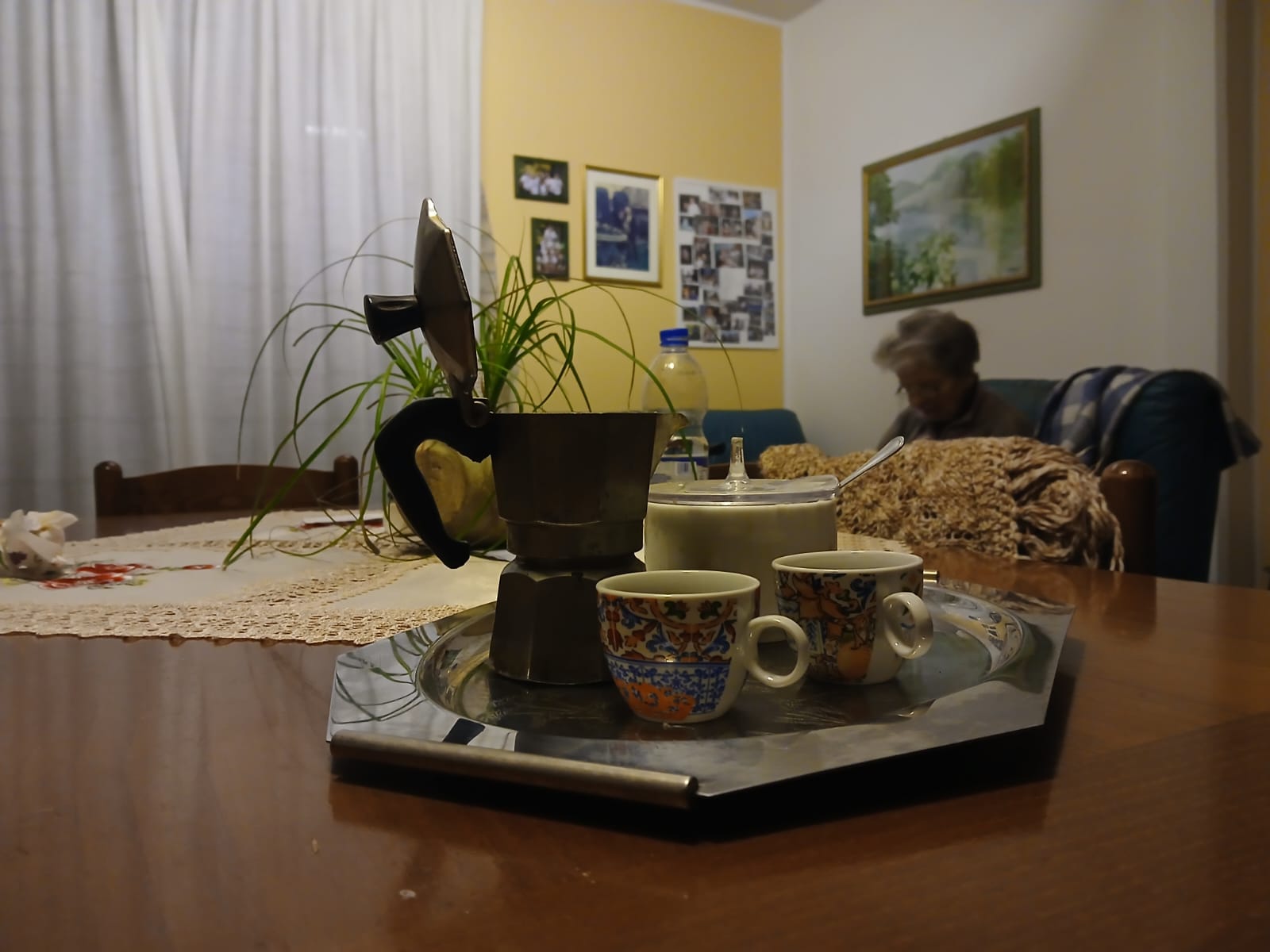
Veneto region, Italy. A few weeks ago, I was having my after-lunch coffee with my paternal grandmother. It’s our tradition: whenever I’m home, after lunch, I go to her place, and we have a coffee together. She moves a bit slowly because of her age (she’s turning 86 this year), but she prepares the moka pot, the little cups, the biscuits, and sometimes spoils me with candies. We talk about this and that — ciacolare, as we say in our dialect.
“xe morta a Maria Mestriner, a gavea 92 anni”
(“Maria Mestriner died; she was 92.”)
“di cosa è morta, nonna?”
(“What did she die of, nonna?”)
“a iera na tacada ai schei che a se morta de fame”
(“She was so attached to her money that she died of starvation.”)
Given how surreal the answer was, I obviously burst out laughing.
We chat for about an hour. The Second World War, her blood pressure pills, my grandfather, the “fascists” on the church council, the ingredients for Easter focaccia. Once we finish our coffee, I kiss her on the cheek, “See you later, bye!”
I think back to her comment about Maria’s death and laugh again. Venetian humor will never stop surprising me. With my friends from other regions, I share a humorous language that we’ve built over time, and we laugh a lot, but nothing compares to the humor of my region. It’s sarcastic, often irreverent, and cynical.
Today, I talk of my dialect with a mix of affection and nostalgia, and to explain this feeling to you, I need to take a step back.
I was born and raised for eighteen years in a small town of four thousand people in Veneto (the region of Venice, to be clear). My parents have lived their whole lives in my hometown, and so have my grandparents and great-grandparents. If I took a DNA test, I’d be surprised to find ancestors from beyond a 200-kilometre radius.
Once I left home for my studies, I found myself, for the first time, embarrassed by my origins. I spent my university years rejecting my Venetian identity. I spoke little and, if I had to speak, I tried to hide my accent. It was as if I wanted to uproot myself from everything; suddenly, I came from a sort of enchanted, nonexistent place. I was stateless by choice: I was no one, I came from nowhere.
One thing bothered me in particular: my dialect. With a self-proclaimed intellectual superiority (oh God), the Venetian dialect amplified the image I had created of Venetians, making them seem cruder, simpler, and more conservative than I thought. Dialect was a tool of impoverishment: it made the people who spoke it look backward, ill-suited to the present, to the way the world was moving.
I spoke three languages; I could go anywhere and communicate with almost two billion people; I knew the right path, looking toward the future.
I essentially understood nothing.
I’m not entirely sure what made me change my mind about my dialect. It was a series of small things, small realizations. Living abroad, in different places, helped a lot.
In the communities I found myself in, I would look for what I called “local reality.” In its simplicity, I wanted to understand and discover—through music, dancing, singing, food, religion, clothing, games, celebrations, relationships—the past that had shaped the people in front of me. And yes, I looked for it in the local languages too.
How much I loved hearing the stories of people who, living in small regions, tried to teach their children their dialect because, with national linguistic standardization, it risked disappearing within a generation. How much I loved knowing that you only had to move a few kilometres to encounter different accents and variations of the same words. How much I loved seeing foreigners value the local dialect of the place where they were living, trying to study it and speak it despite the grammatical difficulties. I loved all of it.
And at a certain point, I realised something simple but revolutionary at the same time: just as I valued the linguistic and cultural heritage of other countries, I could — and should — do the same with my own. If I accepted the existence of all the things I liked (and didn’t like) elsewhere, then I had the obligation to legitimise those of my own region as well.
This Newtonian revelation changed the way I interpreted things. Today, my relationship with the dialect is different. I don’t speak it every day, I don’t master it the way my grandparents do, but when I hear it, I recognize it as a part of me. And just as I’m recovering it, I realize it’s disappearing all around me. People my age hardly speak it anymore, children barely understand it, and in cafés I hear Italian far more often. What was a mother tongue for my grandparents is becoming a relic for my generation.
It’s paradoxical: the closer I get to my dialect, the more I realize it’s dying.
Faced with the sense of powerlessness I feel about this, I childishly look for someone or something to blame. I think of the media — TV, radio, newspapers, social networks, cinema, series — where the space devoted to dialects is practically nonexistent. I also think of national and regional policies that failed to give local languages a place in educational, professional, and institutional spaces, instead pursuing a national linguistic uniformity whose roots go back to Fascist Italy.
Then there’s another aspect: the intellectual romanticization of dialect (and of popular culture more broadly). On the one hand, there is a public discourse that praises the beauty of local languages, using them as symbols of roots, of “territory.” But on the other hand, it is often precisely these intellectual classes who don’t actually speak the dialect; they celebrate it from the outside, the way one exoticizes a foreign culture: admired, referenced, but not lived. And this gap between celebration and actual use reinforces the idea that dialect belongs to the working and rural classes, uneducated and backward.1
But then, how do you save a local language?
I don’t know, nor do I pretend to. But I came across an interesting idea in an article that proposed the concept of a “roof language.” According to this perspective, to save local dialects, they should be given a “roof language”: a shared reference variety, a dialect that can serve as a guide and keep local variants from being diluted into the national language, in my case, Italian. The article explains how this system already works in regions such as Sardinia (Italy) or Catalonia (Spain). The roof language does not replace local dialects, but rather supports them by providing words, grammatical structures, and shared forms. The author shows how this process can prevent total extinction, because it supplies a common structure from which the language can be rebuilt even if a specific local variant disappears.2
I find this proposal interesting because it sits somewhere in the middle: it’s neither the folkloric nostalgia of Facebook pages posting black and white photos of the “good old days,” nor the political rhetoric of certain parties that turn dialects into identity flags to feed division. Instead, it’s about imagining a serious cultural investment that goes beyond sentimentalism.
In this sense, introducing dialect into educational spaces, professional contexts, and even institutional settings could foster the emergence of regional bilingualism. A model already implemented elsewhere, which grants equal dignity to local languages and allows them to coexist daily alongside Italian.
Venetian dialect is no exception, because the disappearance of local languages is a global phenomenon. The Atlas of the World’s Languages in Danger, published by UNESCO in 2010 and currently under revision, defines a ranking of six endangerment categories: extinct, critically endangered, severely endangered, definitely endangered, vulnerable, and safe — depending on how many generations and how many speakers still use the language. According to the data published, around 2,500 languages in the world are at risk of extinction. Many could disappear by the end of the century; for others, the timeline is just a few years.3
And I’m not talking only about dialects overseas: it happens here in Greece too, for example.
Greece has a linguistic diversity that is little known outside the country, yet rich with influences from different peoples over millennia, like Turks, Romanians, Albanians and Italians.
For instance, Cappadocian Greek and Tsakonian are two languages classified by the Atlas as critically endangered, meaning there are only a few thousand speakers, mostly elderly, placing them at extremely high risk of extinction. Or Arvanitika, spoken in southern Greece, which has a few thousand more speakers but is still classified as severely endangered.
And even though I know absolutely nothing about these languages, nor about the people who speak them, I can’t help but empathize with the fact that they are disappearing. The languages change, the countries change, but the story is the same.
The extinction of a dialect is the end of a story, however long or short it may be. And the more time passes, the more it fades — becoming a flat, insignificant memory you find written in books. Beyond the words, what disappears is the humor, the nuances of affection, the proverbs, the memories passed down through an entire population. Because a dialect is not just a linguistic code, but it is a living archive.
I probably would never have laughed so much at my grandmother’s absurd joke about Mme Maria if I didn’t have this background of awareness. A little bitter, it’s true, but dramatically realistic.
