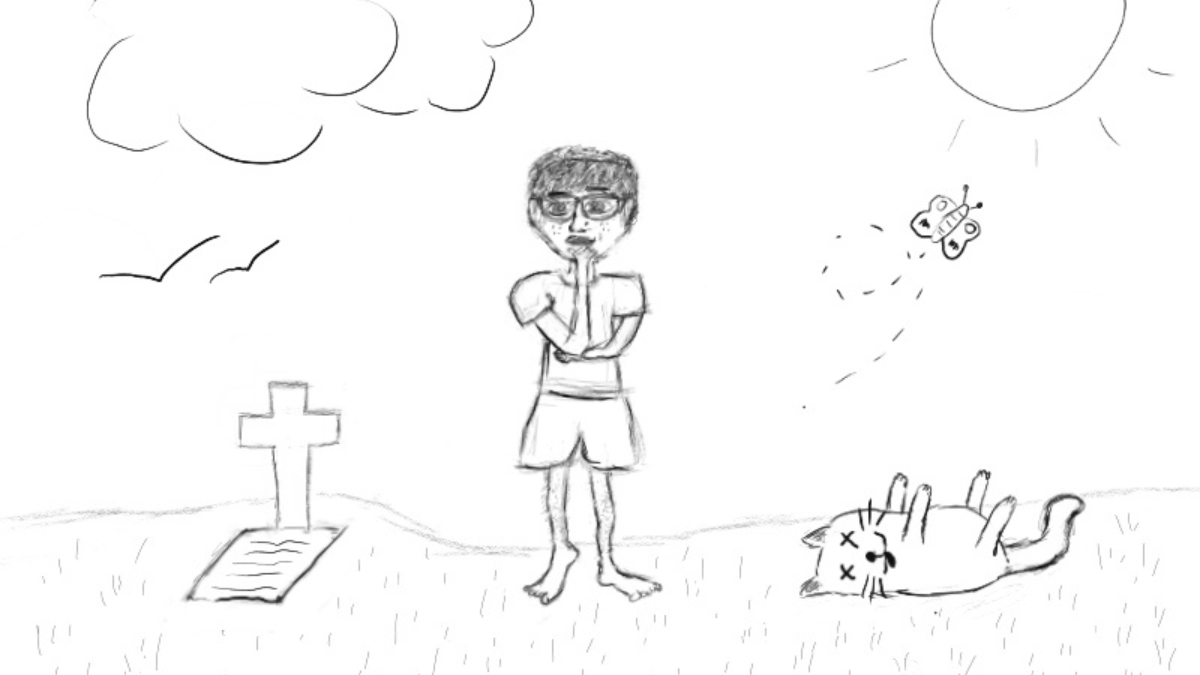
It’s been about a year since my kitten died. He died in the middle of the road, and thankfully, my sister wasn’t home. I saw him dead around ten at night. I don’t know how long he had been there. I saw him lying still in the road, and I stood at the front door, motionless myself, not quite understanding what had happened. I dropped my things where I stood and ran to the shed to grab a shovel before my sister came home. Once I had it, I ran back to the main road to collect his body. The moment I lifted him, I understood. I understood that my beloved kitten was gone.
At that moment, I felt as though I was burying my best friend with my own hands. I dug a small hole, barely holding myself together, placed him inside, and covered him by crushing the sand with my palms. I stood there for the next two hours, staring at the same spot. Deep down, I knew that what had just happened was tragic, both for me and for my sister.
For some reason, my life became entangled in a complex and seemingly unsolvable way. My best friend died, the reason why I grew closer to my sister. With that kitten, I never had to explain myself or justify my thoughts and worries. He was always there, lying on his back with his belly exposed, completely trusting. He was, in every way, everything one could ever ask for from a pet. He simply existed, and that was enough.
The way he came into my life was unexpected. He was helpless, searching for his mother, a cute, small thing. My sister’s and my companionship was enough for him to forget her, though.
He thought so little, cared so little about her absence. His levels of anxiety were pitifully low; for a kitten like that to survive on the streets would have been nothing short of a miracle. Yet we used to let him outside, because of my father, and because that’s all we knew.
The way he died was also unexpected. He was hit by a car on the main road right outside my house. His fur was black, invisible in the dark, especially when he darted into the middle of the street while the driver was going 80 kilometers an hour.
No one could really understand what this death meant to me. No expression of sympathy was ever enough; there is never enough compassion to make someone truly share in your grief. The death of a loved one is considered a tragedy, an acceptable reason for deep sorrow. You can even take time off work. But I had to go to work the next day, and the only sympathy I received was an awkward silence.
It’s hard to understand this kind of pain. If he had lived just one more week, I would have taken him with me to the house where I now live, far from busy roads and cars speeding by at 80 kilometers an hour. He would have lived with me there, in the same house where my two new cats now live.
That’s the same house where, a year ago, I lived with my grandmother, who also passed away a few months after my kitten’s death.
My grandmother was 83 and had been living with dementia for almost two years. She passed away at the end of 2024. Living with someone in that condition can change your life in many ways, as it certainly changed mine. We were never very close, though I knew she loved and cared for us. I have many beautiful childhood memories with her, yet I always felt there were personal differences between us that kept us apart. In short, the love we had for each other was somewhat superficial, shaped by the social obligation to love every member of your family.
We lived together for a year, during what was, for her, the worst stage of her dementia. For me, that meant that alongside my work and studies, I also had to handle her endless cycle of repeated questions. At first, things were manageable, and I had enough patience to respond kindly. But the situation got worse every day, her anxiety grew, and her memory faded. At some point, if I were gone for two days, she would forget my name. Her life had shrunk to the couch, the television, and the endless repetition of her fading mind.
It was painful. I couldn’t rationalize it; I was consumed by my emotions. It was clear that she needed help I couldn’t provide. Her condition worsened daily, and her will to live was gone. It’s heartbreaking to watch a person you’ve known your whole life reach that state, to exist like that.
She died a few months after the summer. She had been bedridden after a stroke, a completely different person by then. Her death, at first, meant relief, for her and for all of us. I knew that, practically speaking, my grandmother, the person my family had loved, had been gone two years earlier, at the onset of her dementia. Still, her funeral was hard for me. I realized that the person lying there before me, inside the church, I would never see again. I cried and mourned more than I ever had in my life. And all this for someone who, in theory and in practice, had already drifted away from any true sense of love.
The funeral felt long, at least to me. As far as I remember, we were in the church for about an hour, but it felt more like two. I wasn’t even sure who I was crying for. Was it because I knew I would never see her again, or because the whole ceremony struck me as macabre? I still can’t say for certain.
What I do know is that something strange happened in the way I experienced it all. The image of my beloved cat kept resurfacing, and combined with what I saw before me, it felt as if I were witnessing the continuation of his death. It didn’t feel like a new loss, but rather an extension of the first, a confirmation that the most precious creature I had ever had was truly gone, now together with someone I loved and had known my entire life.
I felt strange about this, and I think I still do. The death of my grandmother, a human being and above all a member of my family, felt less significant than the death of my cat.
.
.
:
A year and a half later, the sadness isn’t sharp anymore, but it hasn’t gone away.
And grief, I’ve learned, doesn’t shrink with time; it just changes shape, softens at the corners, learns how to coexist with joy. I am not ‘’moving on’’, but, strangely, ‘’moving with’’, carrying everything and everyone I’ve lost, not as a burden, but as a map of the love and loss that shape me.

