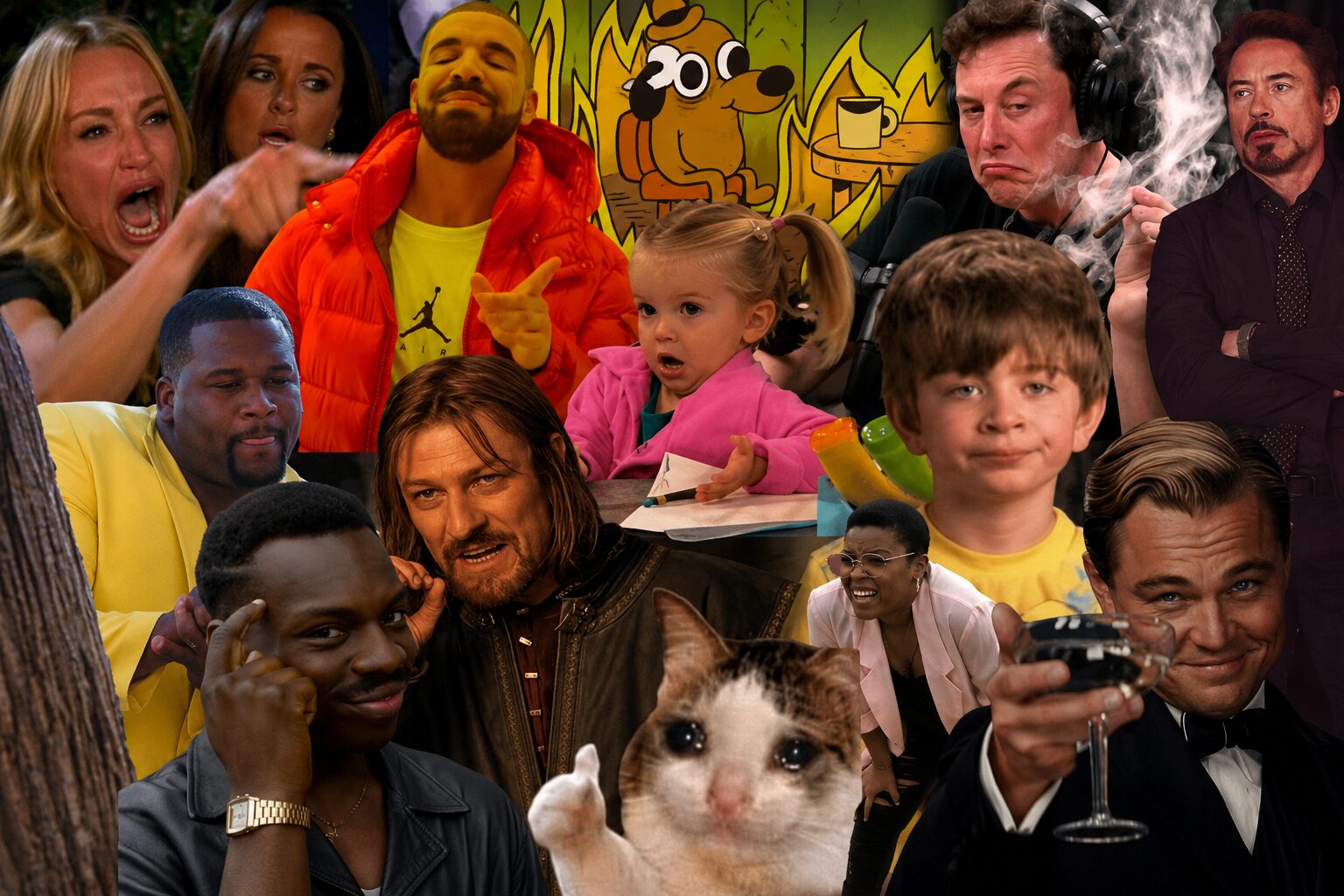
Three billion people spend time on social media every day, and over 60% of them are there purely for entertainment. Statistics show that millennials look at 20 to 30 memes a day, and 77% of Gen Zers use them in their daily communication. According to statistics, 7–8 million new memes are created every day. Honestly? I don’t buy it. Given the endless stream of Reels and TikTok videos, consumption rates are skyrocketing, and these numbers are already outdated by the time I finish this sentence. Chances are, you’ve already scrolled through your daily dose of funny images today—they’ve become as much a part of your routine as your morning coffee. What started as a joke has quietly become the primary tool for how we convey ideas and interact with one another.
I love memes and believe they should be viewed as a cultural phenomenon. But first, let’s figure out the origin of this term. Richard Dawkins provided the canonical definition back in 1976 in his book “The Selfish Gene“. He took the Greek word “mimeme“ (imitation) and shortened it so that it rhymes with “gene.” According to Dawkins, a meme is a unit of cultural information. His idea was that culture evolves according to the same Darwinian principles as biology — it can “reproduce” by jumping from person to person. Culture does the same, just as genes reproduce by jumping from body to body via sperm and egg cells, units of information, in this case memes reproduce by jumping from brain to brain.
In this sense, an idea is a pure-bred parasite. It takes over your brain and uses it as a greenhouse for its own reproduction. Memes don’t necessarily have to be useful to humans; they “want” only one thing — to be copied. Dawkins even called religions “mind viruses” because of their ability to self-replicate. That’s why we can see just how accurately this definition describes the modern use of the word. The same cannot be said for the word’s earliest uses in an internet context, which referred to humorous visual communication online. The first examples of what we now call internet memes were Dancing Baby (1996) and the Hamster Dance (1998).
It’s hard to say exactly how memes have shaped our identity, but they’ve certainly helped us embrace our own vulnerability. From the legendary “Grumpy Cat” to the irony surrounding chronic burnout or social anxiety — memes have become a form of collective therapy. Scientists call this “relatable culture” (from relatable — something that resonates with me). When I see an image that funnyly mocks my procrastination, I feel a wild sense of validation: “Thank God, I’m not the only idiot out there”. Memes build emotional bridges where ordinary words sound too pretentious or dull. We accept our weaknesses through laughter, turning paralyzing stress into a shared object of mockery. This gives us that same sense of belonging to a pack that we so desperately lack.
Think about it: memes fit into postmodern culture like nothing else. Their defining feature is intertextuality. To get the joke, you have to know exactly where it came from, who influenced it, and what it’s referencing. It’s an entire cultural layer: creators often use hyperbolic imagery that only a specific “target audience” will understand. And judging by how often people beg in the comments for “explain the meme,” information moves so fast that we physically can’t keep up with it. Memes often become the primary source of news — and this is probably a good way to stay up to date without falling asleep over longreads.
Sometimes memes are born from an attempt to unite people around a shared tragedy. When Ukraine was suffering massive rocket attacks, hundreds of memes appeared about the air raid map and the absurdity of what was happening. It became easier to cope with the experience of war, so memes became a mechanism of collective coping. We transform fear into an object of ridicule, lowering our cortisol levels. Our psyche is simply trying not to break down.
For example, the nuclear threat became a widespread meme, along with how people jokingly agree in advance to spend the day together when nuclear bombs are falling. To a foreigner, this is pure absurdity. To a Ukrainian, it is an act of supreme psychological resilience. We laugh in death’s face, making it “unserious.” But there’s a catch. Constant mockery leads to desensitization — a loss of sensitivity to real danger. When endless suicide attacks become the subject of endless jokes, there is a risk that we will stop being vigilant where it is critically important. If everything becomes a subject for jokes, the line between reality and a digital game becomes blurred.
And here’s the dark side. Memes are the perfect “Trojan horses” for our brains. When you laugh, your critical filter shuts down. Humor makes you receptive, and the idea slips into your head, bypassing critical thinking. The brain processes a meme in 2–3 seconds—not enough time for analysis, but enough for the image to stick in your memory. It’s a flawless weapon for propaganda, marketing, and political games. People are increasingly talking about “memetic warfare” as a form of hybrid influence on elections and people’s views.
As part of the Russian Doppelgänger campaign, memes were created, disguised as folk humor, that promoted anti-European themes. The 2016 U.S. presidential campaign resembled a full-blown meme war, featuring the famous Pepe the Frog. We are seeing the same thing now in the U.S.-Iran-Iraq conflict; in particular, part of Iran’s “meme war” consists of popular AI-generated Lego-style videos that are spreading massively on TikTok and X.
In other words, we are now witnessing a situation where political parties, representatives of various subcultures, and businesses are all vying for the attention of information consumers. Today, it doesn’t matter where you live—you are a participant in the information war. The 2025 report by NATO’s Chief Scientific Advisor discusses cognitive warfare.Previously the focus layed solely on information warfare — in this case information were the primary tool — now there is a systemic struggle for control over thought processes, in which information is merely one element.
Long before this shift happened, Yuval Noah Harari warned about such phenomenons in his works (particularly in “21 Lessons for the 21st Century“). He announced that humanity has become “an animal that can be broken” through control over information and algorithms. He emphasizes that in an era when the consequences of information attacks are more devastating than nuclear ones, we must realize: if we do not control our minds, others will control them.
You know about media literacy — it’s a basic skill that’s almost embarrassing to mention. But right now, I want to emphasize the importance of intellectual courage. This is the ability to resist the “herd effect,” when you don’t let the number of likes be your measure of truth. It is the willingness to question a statement that the majority agrees with, even if it threatens to make you uncomfortable. It is the courage to pause in the flow of the crowd and ask yourself, “Stop. What is this really about? Why do I believe this?” Firstly, this way you won’t fall victim to manipulation, and you won’t let propaganda go any further. Second of all, it’s charismatic.


