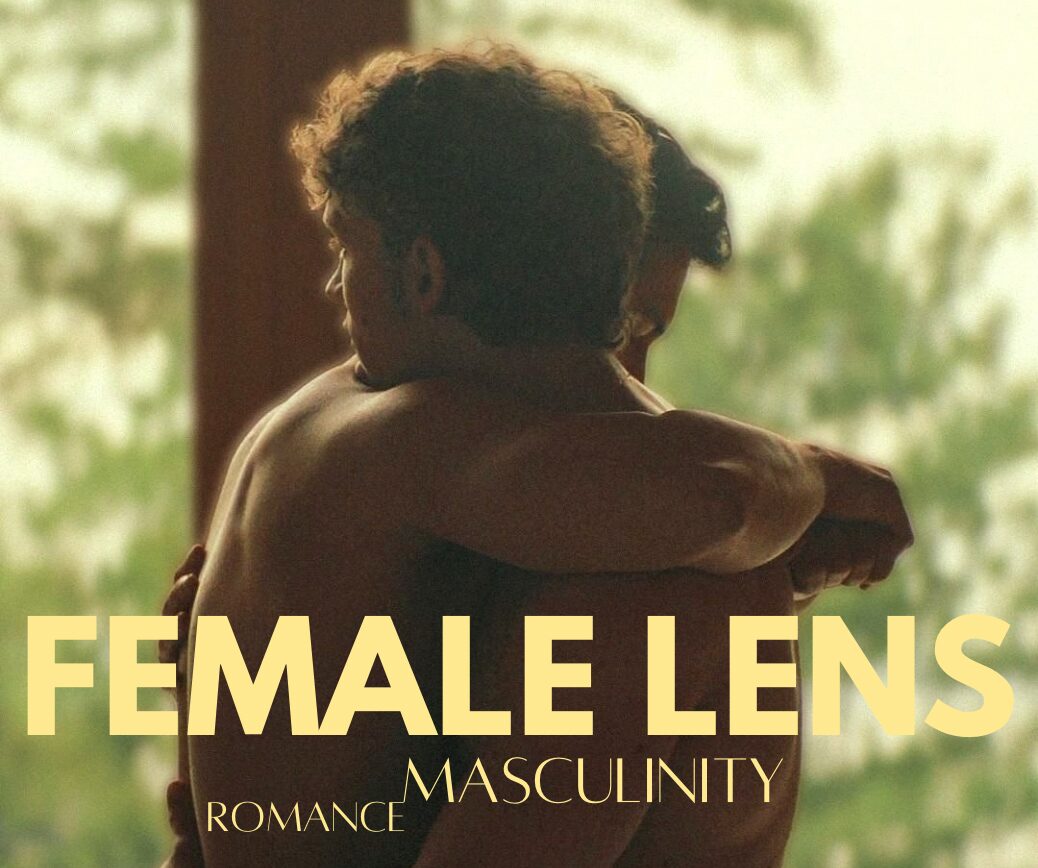
by Paula Expósito Cabrera
Good day, dear reader.
Before we begin to question the way we live and relate to one another, I’d like you to put on your headphones, open your go-to music app, search for I’ll Believe in Anything by Wolf Parade, and press play so we can situate ourselves and connect deeply with the topics we’re about to explore.
Now let’s sit down, enjoy ourselves, and discuss how the way we make space for certain kinds of content, such as a TV show, matters a great deal.
We all know that sometimes we just want to escape and disconnect for a few moments from the reality around us, to set aside the worries that overwhelm us or the feelings that weigh us down. Many other times, we simply want to pass the time, have a laugh, or have something playing in the background. Why is it so important to give visibility to stories that explore romance and masculinity? How beneficial it might be for us? What does it convey to us? How does it affect certain communities? The importance of representation? The importance of expression? If you think about these questions more often than you’d like, as happens to me, my friend, you’re in the right place.
With the recent release of the widely acclaimed Canadian show, based on the books by Rachel Reid, I’ve found myself reflecting on the reason behind this phenomenon. I mean, having watched it, I can say that yes, it is really good, but what makes it so special? Why does this type of series tend to attract such a specific audience?
Heated Rivalry begins as a series about rival hockey players who, due to factors such as the pressure of hegemonic masculinity in ultra-masculinized sports, the repression of people outside heteronormativity, or simply a lack of self-understanding, find themselves needing to hide their passion, their bond, and their feelings for years. This is, in addition, of course, to belonging to opposing teams, which would completely undermine the narrative built around them.
I won’t say more, because the interesting part is that you get to watch it yourself and interpret those scenes in detail. I won’t be the one to take that opportunity away from you.
But let’s get to the important part. On social media, I’ve noticed that a large percentage of this audience is made up of women, and this has meaning and purpose. Romance between men removes a common trigger: the female body as an object of desire. When desire is focused exclusively on two equals, there is less pressure and a greater sense of freedom.
Female viewers find a new perspective when romance moves away from the rigid masculinity we’re used to. Queer men who choose and prioritize connection, express their needs, and distance themselves from emotional shutdown and dominance ultimately become especially appealing.
Many women respond more intensely to enthusiasm, reciprocity, devotion, security, and emotional tone within relationships. For this reason, shifting the focus beyond bodies or gender allows desire to transcend the visual and gives context a central role.
In Heated Rivalry, we can observe these kinds of dynamics. Beyond the intimacy portrayed, it’s interesting to analyze the in-between space, where the journey toward a more genuine vulnerability is shown. The narrative centers on the emotional and realistically explores the complexity of the characters, allowing viewers to understand their internal struggles and the difficulty of forming bonds. All of this becomes part of the female gaze.
We’re used to finding the same gender stereotypes in series and films: women are expected to be communicative, sensitive, and vulnerable, while men are not only denied this space due to the rejection of what has been socialized as feminine, but are also consequently assigned a more closed-off relationship with their emotions, associated with coldness and authority.
In contrast to this repeated framework of roles and power imbalances, it is particularly interesting to observe characters who move away from these impositions and explore other ways of being and relating. This shift is where so-called new masculinities emerge, not as a rigid concept, but as a possibility to rethink masculinity through sensitivity, self-criticism, and a break from traditional models.
On the other hand, this series has also been beneficial for athletes who belong to the LGBTQIA+ community, as in many cases they have been forced to repress and hide parts of themselves due to the very factors mentioned earlier and reflected in the series itself.
Athletes such as Joshua Cavallo, a football player, expressed this in his latest Instagram post: “Decisions were made by people in power that blocked my opportunities, not because of my talent, but because of who I choose to love. (…) This was exactly the fear I had about coming out, seeing prejudice affect my career in modern day.”
Hockey player Jesse Kortuem also shared a Facebook post in which he credited the series with giving him the courage he needed to tell his story: “For a long time, however, the rink did not feel like a place where I could be all of me. I felt I had to hide parts of myself for far too long.” (…) “I spent every week in a locker room with guys I respected, yet I still did not feel safe enough to tell them who I truly was.”
Stories like these highlight how powerful a single series can be in influencing real-life experiences. By reflecting the struggles faced by many viewers, it not only validates their feelings but also fosters understanding among a broader audience. In this way, representation ceases to be an isolated gesture and becomes a decision with real consequences.
Because in the end, when we decide which films to keep watching, which series to keep consuming, and which stories to give space to, we are also deciding which realities we continue to believe in and which ones we continue to silence. Perhaps we don’t always want to think too much about it, and that’s okay. But if this series manages to cross the screen and give a voice to those who went without one for so long, then it stops being just entertainment. It becomes a refuge, a mirror, and for some, the first safe place where they can finally be themselves.


